

Anonymous Contact for Parked Car Occupants and Owners
You can give a parked-car owner a private way to contact you without displaying your personal phone number. For a formal complaint, the rules may differ: official municipal guidelines often require accurate contact information to process a complaint when you choose to provide it. An anonymous contact for a parked car can support a neighborly note, but it does not replace information required by a reporting process.
It’s understandable to want to help without inviting unwanted calls or sharing personal details with someone you don’t know. The key is to distinguish a private message between people from a report to local authorities, then choose the right approach for the situation.
This guide explains how to give parked-car occupants useful information, share a way to reach you while protecting your privacy, and decide when a formal parking report is more appropriate. You’ll also learn how a QR-code sticker from Curb Samaritan can make a considerate, private message easier to send.
Key Takeaways
- Decide whether you’re offering a considerate heads-up or reporting a parking concern; each calls for a different approach.
- Keep a note brief, calm, and focused on a helpful next step rather than blame or assumptions.
- Protect your privacy by sharing only the contact details you’re comfortable providing, and understand that formal complaint processes may require accurate contact information.
- Use extra care when contacting an owner directly, especially if the situation feels tense or could be handled through property management.
- Apartment managers and businesses can make communication easier by sharing a neutral message without identifying who raised the concern.
Providing contact information
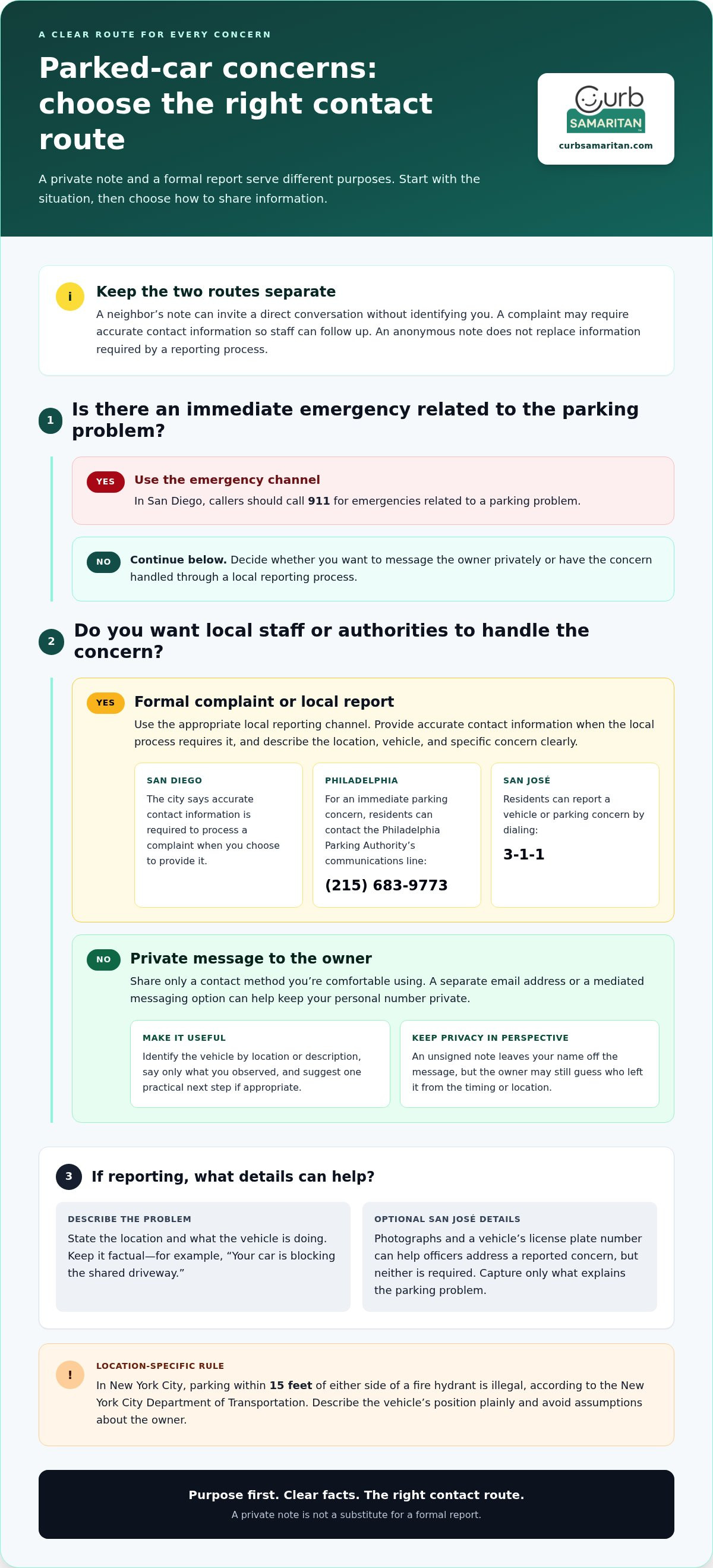
Before sharing your details, decide what kind of contact you’re making. A neighbor’s note, a building notice, and a formal complaint serve different purposes. A note can invite a direct conversation without identifying you. A complaint may require contact details so staff can follow up. Keep the two routes separate, especially when a vehicle blocks an entrance or creates a safety issue.
In San Diego, the city says accurate contact information is required to process a complaint when you choose to provide it. That requirement applies to the complaint process, not a personal note for a driver. If you want staff to handle a concern, use the appropriate city reporting channel and provide accurate details when submitting your information. Don’t assume an anonymous note counts as a city report.
For an immediate parking concern in Philadelphia, residents can contact the Philadelphia Parking Authority’s communications line at (215) 683-9773. In San José, residents can report a vehicle or parking concern by dialing 3-1-1. These examples show why location matters: the correct way to share contact details depends on the city and the purpose of the message. Identify the vehicle’s location first, then choose a local reporting route or a private message.
When submitting a local report, include details that can help staff identify the issue. In San José, photographs and a vehicle’s license plate number can help officers address a reported concern, but neither is required. If you choose to include them, capture only what explains the parking problem. For example, show how a vehicle blocks a driveway rather than photographing nearby residents or unrelated activity.
- For a private message: Share only a contact method you’re comfortable using. A separate email address or a mediated messaging option can help keep your personal number private.
- For a formal complaint: Give accurate contact information if the local process requires it. Describe the location, vehicle, and specific concern clearly.
- For an urgent safety issue: Use the relevant emergency channel. In San Diego, callers should call 911 for emergencies related to a parking problem.
Keep the message factual. Write, “Your car is blocking the shared driveway,” rather than guessing why the driver parked there. Include the location and the action needed, such as moving the vehicle so residents can get in. A calm, specific message gives the owner a useful next step without turning a parking concern into a personal accusation.
Location can also determine whether a report describes a clear parking violation. In New York City, parking within 15 feet of either side of a fire hydrant is illegal, according to the New York City Department of Transportation. If that is the concern, state the nearby hydrant and the vehicle’s position plainly. Avoid adding assumptions about the owner or making threats.
San José tracks vehicle concern complaints, although staff can’t act on every complaint, and uses the data to guide future service priorities. Clear descriptions can therefore be useful even when a report doesn’t lead to immediate action. Keep your own record of the date, location, and message sent. Don’t publish the driver’s personal details or turn a private concern into a public confrontation.
Can I leave an anonymous note on a parked car, and what should it say?
You can leave the parked-car owner a brief, unsigned note. Keep it courteous, factual, and focused on one helpful action. For example, if the car’s lights appear to be on, describe what you noticed without assuming the battery is failing. An unsigned note keeps your name off the message, but the owner may still guess who left it from the timing or location.
Start by deciding what the owner needs to know. Include the car’s location, the visible concern, and one practical next step. Avoid comments about the driver’s character, motives, or habits. “Your rear window appears open in the rain” gives useful information. “You’re careless” adds blame and doesn’t help the owner respond.
A short message is easier to understand at a glance. Try this structure:
- Identify the vehicle by location or a simple description.
- Describe only what you observed.
- Suggest one practical next step, if appropriate.
- Close politely, without adding personal details.
For example: “Hello. Your blue car is beside the north entrance, and the trunk looks open. You may want to check it. A neighbor.” This gives the owner a location and an observable detail. It doesn’t accuse them or claim anything was taken. Say “may want to check” rather than presenting a guess as fact. That keeps the note helpful, not alarming.
Choose a place where the note is easy to notice and won’t interfere with the vehicle. Don’t put it where it could block the driver’s view, cover a warning, or damage a surface. If the car is near a shared entrance, mention the entrance rather than writing on the vehicle. A note tucked safely under a wiper is familiar, but don’t force it into a door seal or window gap.
Keep the paper clean and the writing legible. A torn scrap with unclear wording can look like litter or a threat. Use a plain sheet and ordinary language. Avoid dramatic wording, repeated punctuation, all-capital warnings, and threats to call authorities. If you need to make a formal complaint, use the appropriate local reporting process rather than presenting a note as an official notice.
Don’t include details that reveal more about you than the message requires. Leave the note unsigned or use a neutral sign-off such as “A neighbor.” Avoid adding your home address, work schedule, or personal phone number if you don’t want direct contact. An anonymous contact for a parked car should protect your privacy without making the message confusing. Remember, handwriting and timing may still offer clues about who left it.
Before leaving the message, reread it from the owner’s perspective. Could they understand the concern without knowing who you are? Does each sentence describe something you personally observed? Remove guesses about intent and demands for an explanation. For a shared bin area, you might write, “Your car may be blocking access. Could you leave room for residents?” An anonymous contact for a parked car works best when the message is specific, calm, and easy to act on.
If the situation feels tense, the note could be misunderstood, or the issue needs official attention, don’t use an unsigned message instead of the proper process. For a simple courtesy, keep the note specific and kind. For a serious concern, report the facts through the relevant local channel.
What are the risks of leaving a note or contacting a parked car's owner directly?
A short note can help, but the owner may read it differently than you intended. “Your car is blocking the driveway” may sound like a warning, even if you mean it as a neighborly request. A phone call can feel more personal because it reaches the owner directly. Choose wording that describes the issue, not the driver’s motives.
Privacy is another concern. A handwritten note can reveal your identity through your name, number, handwriting, or where you leave it. Sharing a personal phone number may invite replies beyond the original parking concern. Before adding contact details, decide whether you’re comfortable receiving a call or text. If not, leave them off or use a method that keeps your personal number private.
Direct contact can also escalate a disagreement. A driver might feel accused, especially if the message mentions repeated parking or threatens consequences. Keep the exchange focused on one observable issue, such as a car blocking a shared gate. Don’t wait beside the vehicle for the owner, follow them, or continue messaging after they ask you to stop.
- Misunderstanding: “You’re parked illegally” may be inaccurate or sound confrontational.
- Privacy exposure: A personal number or address can invite unwanted contact.
- Vehicle concerns: Placing a note inside a door seal or forcing a window can risk damage.
- Escalation: Repeated messages can turn a practical request into an argument.
Accuracy matters. A vehicle may appear to block access while leaving enough room for people to pass. Don’t state a legal conclusion unless you know the local rule applies. In New York City, the New York City Department of Transportation says parking within 15 feet of either side of a fire hydrant is illegal. For other concerns, describe what you can see, such as a car positioned across a driveway entrance, rather than guessing at a violation.
Think carefully before sharing photographs or vehicle details publicly. A picture posted to a neighborhood group can expose a license plate and invite comments from people who weren’t involved. If documentation would help with a formal report, provide it through the relevant reporting process. Keep a private record of the location and what happened, and leave out unrelated details about the driver.
Timing and setting affect how direct contact feels. Approaching someone in a quiet parking area may feel intrusive, while speaking calmly in a shared building may allow a simple explanation. If the owner seems upset, end the conversation rather than arguing. A neutral sentence such as “I wanted to let you know the entrance is blocked” keeps the focus on access, not blame.
Use a different approach for urgent or serious concerns. A note isn’t a reliable way to address a vehicle creating an immediate hazard, suspected criminal activity, or an issue requiring official action. Contact the appropriate local service and share only relevant facts. For an ordinary inconvenience, a polite message may be enough. If the situation feels tense, avoid direct confrontation and let the proper channel handle the report.
If the exchange becomes tense, end it and use an appropriate reporting route rather than trying to resolve every parking problem yourself. A parked vehicle may raise a different issue if it appears abandoned, and the person who left it may not be able to arrange its removal.
In New York City, the owner of an abandoned vehicle with license plates is responsible for its towing and storage fees. A New York City property owner requesting removal of an abandoned vehicle without license plates from private property must pay a fee based on the price of scrap metal. This distinction is a reason not to promise that a note or call will solve the problem. Keep any message neutral, and don’t confront someone over whether a vehicle is abandoned. If removal is necessary, use the relevant process and check who is responsible for the cost before taking action.
Can apartment managers or businesses notify a parked car's owner without disclosing who complained?
Yes. An apartment manager or business can often pass along a neutral message without naming the person who raised the concern. For example, a manager can tell a resident, “A vehicle is blocking the loading area. Please move it.” The message addresses the parking issue, not the complainant. Keep it factual, and don’t promise that someone’s identity will remain confidential in every process.
Start by separating a private courtesy notice from a formal complaint. A manager might place a general reminder on a vehicle or contact its registered resident through established property channels. A formal report to a city department may follow different procedures. In San Diego, the city says accurate contact information is required to process a complaint when the user chooses to provide it. A manager should distinguish that reporting route from an internal reminder.
For a shared property, managers can make notices consistent. A practical process might look like this:
- Record the vehicle’s location and the specific access problem.
- Check the property’s parking rules and current notices.
- Send a neutral message through the usual resident or tenant channel.
- Keep the complainant’s name out of the message unless disclosure is necessary.
- Document the action taken and any response.
For example, if a vehicle blocks a marked delivery entrance, the manager can identify the entrance and ask the driver to leave it clear. Avoid wording such as “Your neighbor reported you.” That can expose the source and invite a personal dispute. A sign or building-wide message can work for recurring issues, such as vehicles using a reserved loading space.
Businesses can use the same approach for customer or staff concerns. A store manager might ask an employee to make a calm, direct announcement about a car blocking the customer pickup area. A written notice can state the location, issue, and requested action. It shouldn’t include a name, shift schedule, or other detail that points to the person who spoke up.
Confidentiality has limits. A manager can choose not to identify a complainant in a routine message, but shouldn’t guarantee secrecy before understanding the process involved. If the matter becomes a formal complaint, an investigation, or an emergency, the relevant organization may need accurate details. Explain the distinction clearly: “We can send a general reminder. A formal report may require contact information.”
Keep records focused. Note the date, location, vehicle description, and message delivered. Don’t circulate photographs or a license plate among tenants when a private record will do. Share details only with staff who need them to address the issue. If a driver replies angrily, direct further communication through the manager rather than asking the original complainant to handle it.
A consistent process helps residents and customers know what to expect. Managers can post a simple policy explaining how to report blocked access, where notices may be placed, and who handles follow-up. For a one-time problem, a brief neutral reminder may be enough. For repeated or urgent concerns, use the property’s established escalation route or the appropriate local reporting channel.
For issues that may require official action, managers can keep the private reminder distinct from any municipal process and avoid suggesting a particular outcome or timing beyond published procedures. In New York City, the Department of Sanitation will investigate and tag a qualifying derelict vehicle without license plates within three business days. In New York City, most tows of vehicles with a sheriff or marshal boot are completed in 1 to 2 hours.
Curb Samaritan: Driver Sticker
Curb Samaritan’s Driver Sticker gives passersby a private way to alert a vehicle’s owner. They scan its QR code with a mobile device to send a secure, anonymous text message, without downloading an app or sharing personal information. The sticker can help when someone notices an issue with a parked car but doesn’t want to leave a personal phone number on a note.
For example, a passerby could use the sticker to let the owner know about a concern, while keeping the exchange more private than direct contact. It’s designed for everyday communication, not official parking complaints or urgent emergencies. If you’d like to make it easier for people to reach you about your vehicle, visit Curb Samaritan.
Make considerate contact easier next time
A thoughtful message works best when people can respond without turning a small concern into a personal exchange. To make that kind of communication easier around your vehicle or property, choose an option that fits where the message will be used. Curb Samaritan offers the Driver Sticker for vehicle-related contact, the Resident Sticker for home-related messages, and the Found Sticker for found items.
An anonymous contact for a parked car can help a passerby share a useful heads-up without writing your personal number on a note. Consider what details you’re comfortable sharing and whether the message is a neighborly courtesy or needs an official report. A private messaging option can support everyday communication, while urgent or formal concerns belong with the appropriate local channel.
Ready to explore a practical way to keep everyday messages more private? Contact Curb Samaritan and find an approach that suits your community. A little clarity can make it easier for neighbors to help one another.
Frequently Asked Questions
How can I anonymously contact the owner of a parked car in the United States?
For a personal heads-up, use an anonymous messaging option if the vehicle displays one, or leave a brief unsigned note. For example, tell the owner their car is blocking a shared building exit without adding your name or personal number. If the situation needs official action, report it through the appropriate local channel instead. Reporting procedures vary by location, and a formal complaint may require accurate contact details.