

Anonymous Messaging for Neighbors: Privacy-First Guide
You spot a neighbor's car headlights left on at dusk, or notice their backyard gate swinging open in the wind. You want to help, but walking up to their porch feels intrusive, and scribbling your private phone number on a scrap of paper feels unsafe. If you've ever held back from doing a good deed to protect your personal boundaries, you aren't alone. That hesitation is why anonymous messaging for neighbors has become such a vital tool. It gives communities a gentle way to share quick, helpful alerts without exposing personal contact details or joining noisy social apps that track your every move.
Discover how anonymous messaging enables helpful neighborly communication without sacrificing your personal phone number or home privacy. We'll walk through the everyday risks of public community boards, explore frictionless privacy-first tools that connect homes and vehicles, and show you how simple, discreet alerts can foster a friendlier, safer local environment built on mutual aid.
Key Takeaways
- Discover how anonymous messaging for neighbors bridges local helpfulness with personal privacy, letting you send and receive critical updates without sharing phone numbers.
- Learn how dynamic QR touchpoints route real-time text alerts to your existing phone without requiring anyone to download an app or register an account.
- Explore how early, discreet alerts resolve everyday vehicle, delivery, and home exterior dilemmas before they turn into costly repairs or towing bills.
- Compare common neighborhood communication channels to see why private two-way alerts offer a calmer alternative to invasive cameras and noisy community boards.
- Find out how a single household can easily establish secure communication points using physical items like Resident Stickers, Driver Stickers, and QR Code Posters.
What Is Anonymous Messaging for Neighbors and Why Does Privacy Matter?
Living alongside other people brings a strange modern contradiction. We park inches from another family's car and share fences, yet we rarely know the names of the folks living next door. Anonymous messaging for neighbors solves this challenge by enabling private, two-way text communication without requiring anyone to exchange personal phone numbers, full names, or home addresses. Instead of broadcasting alerts to an entire street or staying silent out of caution, you send a direct, helpful note to a specific household while your personal information stays protected.
Surveillance cameras and public social feeds often treat local safety as an exercise in constant monitoring. But building a secure, watchful area does not require recording your surroundings or broadcasting your location to an open online community that requires real-name registration. Genuine neighborhood care thrives when people can communicate easily without exposing their personal lives to strangers.
The Barrier of Over-Exposure in Modern Communities
Leaving a handwritten note on a car windshield or front door sounds simple, but it carries real hesitation. Writing your personal cell number on a piece of paper leaves an open paper trail. Anyone walking down the sidewalk can pick it up, search your number online, uncover your full identity, or send unwanted messages. This exposure causes real friction. When faced with notifying someone about an open garage door or risking personal harassment, most residents choose silence. Over-exposure turns simple, thoughtful acts into unnecessary personal risks.
Kindness Without Vulnerability: The Power of Masked Contact
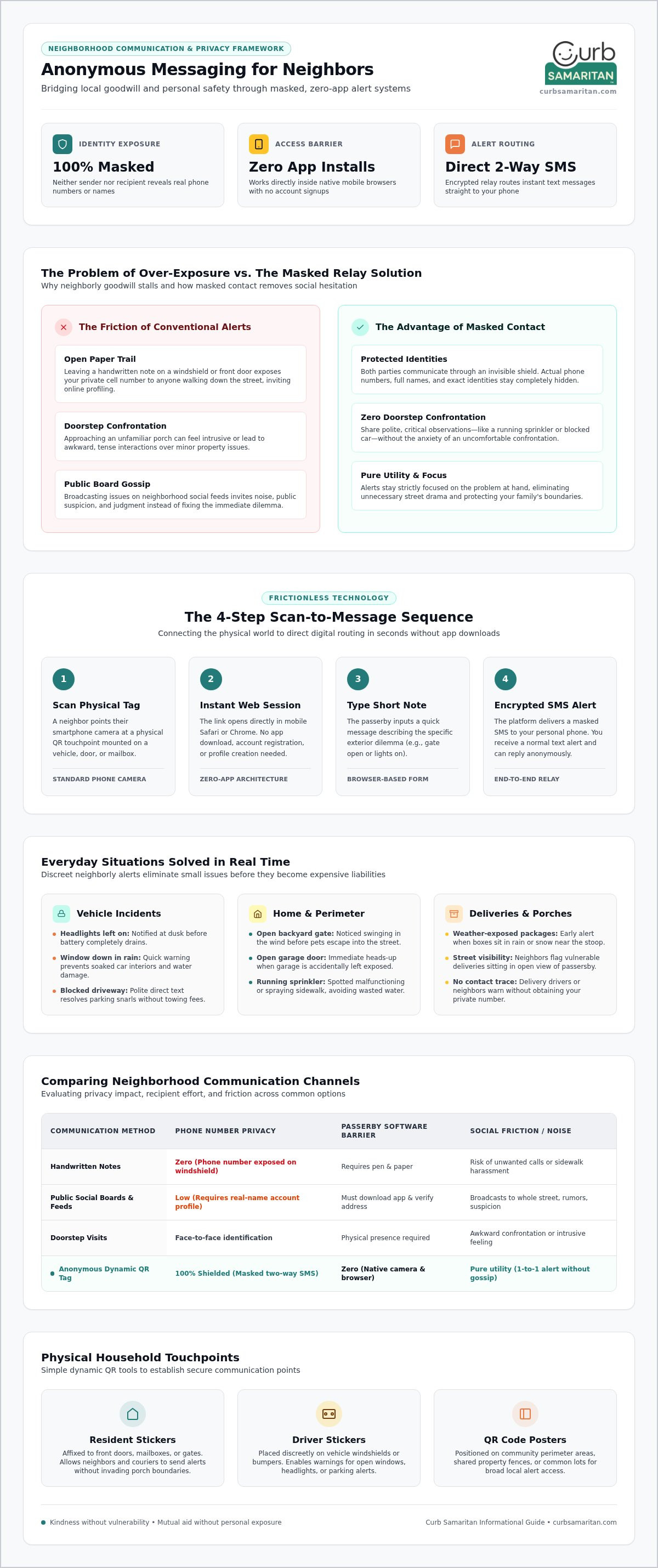
Masked communication changes that dynamic entirely. When you use anonymous messaging for neighbors, alerts flow through secure relay systems that bridge two parties without revealing underlying details. Both sides communicate through an invisible shield:
- Protected identities: Neither sender nor recipient ever sees the other person's actual phone number or personal identity.
- Zero confrontation: You can politely point out a blocked driveway or a running sprinkler without dreading an awkward doorstep argument.
- Pure utility: Conversations stay focused strictly on the problem at hand, eliminating the background noise, social pressure, and gossip common on public neighborhood message boards.
Good intentions should never compromise your family's personal safety. By lowering the social and digital stakes of reaching out, masked contact restores simple, everyday goodwill to the places we live.
How Anonymous Neighborhood Messaging Works Without Apps or Shared Numbers
Most community alert platforms demand a high price for communication: downloading an app, making an account, and verifying your identity. When a passerby spots your car window rolled down during a rainstorm, they will not spend five minutes downloading software just to let you know. Modern anonymous messaging for neighbors solves this problem by removing the software barrier entirely. It connects the physical world to direct digital routing through simple, secure browser sessions.
The Step-by-Step Scan-to-Message Workflow
Reaching an owner takes seconds through an intuitive four-step sequence:
- Scan: A neighbor points their smartphone camera at a physical QR tag mounted on a home, mailbox, or car.
- Connect: The camera opens a private web page instantly inside the phone's native browser. No account registration or login required.
- Type: The sender types a brief note detailing the issue, such as an open gate or package left in the weather.
- Deliver: The platform delivers an encrypted SMS directly to your phone. You receive a normal text, read the alert, and can text back safely.
Neither person sees the other party's phone number. End-to-end masking keeps the thread entirely anonymous on both sides.
Zero-App Technology: Removing Friction for Passersby
Simplicity drives neighborly action. Because the interface runs entirely in mobile web browsers on both Apple iOS and Android systems, anyone can send an alert instantly. Digital rights groups frequently highlight the dangers of crowd-sourced suspicion apps that rely on closed feeds, intrusive profiling, and public broadcast forums. In contrast, zero-app dynamic QR routing keeps interactions local, direct, and focused solely on helpful problem-solving.
Data Protection and Spam Mitigation Protocols
Opening an alert touchpoint must never invite unwanted noise. Modern routing systems enforce automated rate limits to prevent spam and block abusive language before it reaches your inbox. Secure server relays drop data trails once conversations finish, ensuring your details are never compiled, tracked, or sold. If a thread ever becomes unhelpful, you can close communication instantly with a simple reply command.
Setting up this effortless flow for your property is simple with privacy-first tools from Curb Samaritan, giving you quiet confidence that helpful alerts reach you without exposing your private life.
Everyday Situations Where Anonymous Neighbor Alerts Solve Problems
Small oversights can quickly snowball into expensive headaches or damaged community relationships. Most neighborhood conflicts do not stem from bad intentions; they happen because people lack a quick, comfortable way to communicate before frustration boils over. By using anonymous messaging for neighbors, everyday friction disappears. A fast, private note allows problems to be resolved peacefully in minutes, long before anyone considers calling code enforcement, municipal tow trucks, or local authorities.
Driveway and Parking Courtesies
Street parking and shared driveways create frequent friction. Leaving headlights on drains a battery overnight, while parking too close to an apron blocks trash collection or family commutes. Instead of stewing in silence or paying expensive towing impound fees, a quick scan alerts the owner right away. You can explore how a simple vehicle decal handles these situations in our guide to anonymous car stickers for secure alerts.
- Vehicle hazards: Notify drivers about flat tires, open trunks, or headlights left burning.
- Access issues: Request someone pull forward without an awkward face-to-face dispute.
- Cost prevention: Save neighbors from costly tow charges or sudden repair bills.
Home Security, Deliveries, and Property Care
Home exteriors face daily unexpected events while owners are busy inside or away at work. A misdelivered package left exposed on the wrong doorstep invites theft. A broken sprinkler head can flood a sidewalk and waste hundreds of gallons of water. With anonymous messaging for neighbors, anyone walking past can alert you instantly so you can retrieve your parcel or shut off the valve. Learn more about protecting your front entrance in our guide to secure messaging stickers for home privacy.
Lost Pets and Wandering Animals
Strong winds can blow a backyard gate unlatched, letting a curious dog wander into the street. Plastering a personal cell number on a pet collar exposes your identity to anyone who finds your animal. A private dynamic tag lets a rescuer send a text the second they secure your pet, safely coordinating a reunion without publishing your home address. Check our smart pet ID tag lifetime access resource for more details on keeping wandering companions protected.
Comparing Neighborhood Communication Tools: Privacy, Effort, and Cost
Choosing how to manage local communication usually means weighing convenience against personal boundaries. Most households rely on a patchwork of traditional habits and digital networks, yet each method presents real trade-offs:
- Paper notes: Easy to write, but easily blown away by weather and dangerously expose your personal phone number or handwriting.
- Community apps: Wide reach, but demand address verification, encourage public gossip, and clutter your phone with notifications.
- Outdoor cameras: Record incidents passively without resolving them, while often locking users into ongoing monthly subscription fees.
- Dynamic QR messaging: Direct, two-way, and friction-free with lifetime communication access and zero personal data exposure.
Direct Anonymous Messaging vs. Invasive Video Surveillance
Outdoor cameras have become common fixtures, yet they often cultivate mutual suspicion rather than community trust. A lens records footage after an incident happens, but it cannot solve an active dilemma in real time. Pointing cameras at adjacent driveways or shared walkways can also make nearby residents feel uncomfortably monitored. Anonymous messaging for neighbors replaces passive suspicion with active cooperation. Instead of pointing a camera at someone, a physical QR sticker provides an open invitation for respectful, direct dialogue.
Dedicated Messaging vs. Public Social Feeds
Public neighborhood feeds often turn minor oversights into public spectacles. Posting a picture of an idling delivery vehicle or a misplaced trash bin invites gossip and toxic comments from people blocks away. That dynamic damages relationships. Direct, one-to-one communication resolves dilemmas privately and protects everyone's dignity. A direct text reaches the owner immediately on their phone, prompting quick action instead of public defensiveness.
Building a safer environment shouldn't require monthly fees or intrusive cameras. If you want to establish a calm, secure communication channel for your property, order your Curb Samaritan privacy stickers today to connect with your community on your own terms.
How to Implement Privacy-First Communication in Your Community
Transforming how your street communicates does not require convincing an entire block association to adopt complex software. You can begin right at your own front door. Implementing anonymous messaging for neighbors works from the ground up: one home, one vehicle, and one simple touchpoint at a time. When passersby see a welcoming, friction-free way to reach you, they naturally step up to help.
Selecting the Right Physical Touchpoints for Your Needs
Different areas of your daily routine require different solutions. Matching the right physical QR touchpoint to each spot keeps communication intuitive for everyone:
- Driver Sticker: Place this discreet decal inside the lower corner of your windshield. It welcomes alerts about parking pinches, open windows, or forgotten headlights while keeping your private phone number concealed.
- Resident Sticker: Affix this durable tag beside your front door, entryway, or parcel drop box to catch misdelivered packages and property hazards early.
- QR Code Posters: Mount these durable sheets in shared laundry rooms, apartment lobbies, or community boards to manage shared spaces smoothly.
- People & Pet tags: Fasten these lightweight tags to pet collars so anyone who spots a wandering dog or cat can reach you instantly.
For complete household coverage, the Neighborhood Connect Sticker Bundle combines these touchpoints into a unified setup, granting lifetime messaging access without any monthly subscription fees.
Fostering a Culture of Mutual Aid and Respect
Clear touchpoints remove the hesitation that often keeps well-meaning people silent. When someone notices a running garden hose or an open gate, a visible tag invites a quick scan. They don't have to worry about knocking on a stranger's door, and you don't have to worry about giving out personal contact info. Preserving personal boundaries actually brings communities closer together. By making communication safe and effortless, anonymous messaging for neighbors restores the everyday mutual aid that makes any street feel like home.
Take the first step toward a calmer, safer neighborhood by bringing Curb Samaritan touchpoints to your home and vehicle today.
Build a Safer, Friendlier Community on Your Own Terms
A connected neighborhood shouldn't come at the expense of your personal boundaries. Adopting anonymous messaging for neighbors creates a calm bridge for everyday goodwill without inviting digital tracking, public gossip, or awkward doorstep confrontations. Nearby residents can quickly flag small hazards or vehicle issues, while your personal phone number, name, and private data remain completely shielded.
The process remains effortless for everyone involved. Helpful passersby don't need to download mobile apps or register accounts just to send a quick text alert. You receive direct SMS notifications on your standard phone, enjoying lifetime access to secure messaging with zero recurring monthly subscription fees. Looking out for your property and supporting those around you can finally go hand in hand.
Ready to strengthen local trust while keeping your private life secure? Protect your household privacy with Curb Samaritan QR stickers and experience simple, respectful neighborhood communication today.
Frequently Asked Questions
How can I send an anonymous message to my neighbor?
You can send a message by pointing your smartphone camera at a physical QR code on their vehicle, door, or mailbox. The scan opens a secure browser window right away without requiring an account or phone number. Type your message and tap send. The system routes your note to the owner as a standard text alert, establishing a secure two-way thread while keeping both identities private.
Do I need to download a mobile app to use anonymous neighbor messaging?
No, neither party needs to install an application. The primary advantage of modern anonymous messaging for neighbors is that it operates entirely through standard mobile web browsers. Senders simply scan the physical tag and compose their message online. Recipients receive and answer alerts using standard SMS text messages on their existing cellular phones, removing the friction of app store downloads or account verification.
What happens if someone tries to spam or harass me through an anonymous QR code?
Automated security protocols protect your phone from unwanted noise. Built-in rate limits prevent repetitive submissions, and intelligent filters intercept abusive language before text alerts reach your screen. You also stay in complete control of every conversation. If a thread ever becomes unhelpful, you can permanently block the sender or end the session instantly by texting a simple STOP command back to the system relay.
Can my neighbor find out my phone number or name from an anonymous message?
No, your personal phone number, real name, and home address remain completely confidential. When you reply to an alert, the relay system routes your text through an encrypted proxy number. The person on the other end sees only the masked notification interface. You can resolve immediate issues, answer questions, or express gratitude with total peace of mind, knowing your personal digital footprint stays entirely hidden.
Are there monthly subscription fees required for anonymous messaging stickers?
No monthly subscription fees or recurring costs exist. Each physical tag or sticker includes lifetime access to the anonymous routing platform upon purchase. You register the code once to your cell phone number, and it remains active indefinitely. There are no surprise service charges, renewal invoices, or premium feature paywalls needed to keep your household communication lines open and protected.
How does an anonymous sticker work if my car is parked on the street?
Applying a Driver Sticker to the lower corner of your windshield creates a discreet communication point for anyone passing by. If your headlights remain illuminated, a window sits cracked open, or your vehicle blocks street sweeping, a neighbor can scan the tag from the sidewalk. It enables prompt anonymous messaging for neighbors without requiring you to display personal business cards or mobile numbers on your dashboard.