

Anonymous Neighbor Communication: A Privacy-First Guide
What if a neighbor could share a useful alert without asking you to hand over your phone number? That’s the promise of anonymous communication for neighbors: a practical way to get in touch while keeping personal contact details private at the start. It can feel more comfortable than joining a group chat that exposes contact details or approaching someone you don’t know.
This guide explains how to choose a communication route, what each option protects, and where anonymity has limits. No tool removes every privacy concern. Some let people send messages without exchanging phone numbers, while others use profiles or public posts. Whatever you choose, respectful communication and sensible boundaries matter.
QR-coded stickers and tags are one low-friction option. A passerby can scan a code to send a text alert without downloading a mobile app or first exchanging contact details. Understanding the trade-offs helps neighbors share useful information while making that first hello more comfortable.
Key Takeaways
- Understand what anonymous communication for neighbors can protect, and why it doesn’t guarantee complete anonymity or confidentiality.
- Choose a contact route that fits the situation, whether you’re reaching one identifiable neighbor or sharing an alert with a wider group.
- Compare in-person contact, phone-number exchange, group chats, and QR-enabled messaging to see which best balances access and privacy.
- Make alerts more useful by checking urgency, choosing an appropriate channel, sticking to clear facts, and limiting personal details.
- QR-coded stickers and tags can give passersby a way to send a text alert without needing a mobile app.
What Does Anonymous Communication for Neighbors Actually Mean?
Anonymous communication for neighbors lets someone send a useful alert without first exchanging personal contact details, such as phone numbers. It can make an initial message feel more comfortable, but it doesn’t guarantee complete anonymity, confidentiality, or a reply.
The goal is to share what someone needs to know without making a personal introduction a condition of getting in touch. A neighbor might report a misplaced delivery, let someone know they found a set of keys, or pass along a brief heads-up about something near their home. A message can open a helpful line of communication while keeping contact details private at the outset.
For a broader background on anonymity, see the Wikipedia overview of anonymity. In a neighborly situation, it helps to be precise: a private way to make first contact isn’t the same as being impossible to identify.
What kinds of neighbor messages benefit from a private route?
A private route can suit routine, low-stakes messages that may be easier to send than to raise face-to-face. You could alert someone that a parcel appears to have been left at the wrong door, say where a found item is waiting, or mention a household matter that needs their attention. Keep the note specific and courteous so the recipient can understand what happened and decide what to do.
These messages aren’t a substitute for urgent help. If someone faces immediate danger or needs emergency assistance, use the appropriate emergency channel rather than relying on an anonymous neighbor alert. For everyday matters, a message can be useful, but it can’t guarantee the recipient will see it, respond, or resolve the issue.
Does anonymous communication mean nobody can identify anyone?
No. In this context, anonymity usually means limiting the personal contact details shared during initial communication. It doesn’t necessarily hide every clue in a message. A description of a specific doorstep, vehicle, or incident may make the people involved recognizable, even when no phone number is exchanged.
Protect privacy by sharing only what’s needed to explain the issue. Stick to observable facts, avoid unnecessary names or personal information, and keep the tone respectful. A considerate, clear message makes it easier to respond constructively. Think of a private first contact as a practical boundary, not a promise that every part of the exchange stays anonymous.
How Anonymous Neighbor Communication Works in Everyday Situations
A useful alert follows a simple path: notice something, choose the right way to reach the person or people affected, send a short message, then allow time for a reply. With anonymous communication for neighbors, the sender can share information without first exchanging personal contact details. Include enough context for the recipient to understand what happened and what, if anything, they can do next.
For example, if you notice a gate left open beside a shared walkway, a direct alert may be enough if you know which household it belongs to. If a maintenance issue affects several homes, a community channel could reach everyone who needs to know. Contact one person for a specific issue, or use a wider channel when the information genuinely concerns a group.
How should a neighbor write a useful anonymous alert?
Start with what you observed, add the location or detail that helps the recipient check it, and suggest a simple next step. Keep the wording neutral. Avoid guessing who caused the issue, assigning blame, or including personal details that don’t help explain it. Respectful, clear communication can support trust, as the University of Minnesota’s guidance on building trust in communities explains.
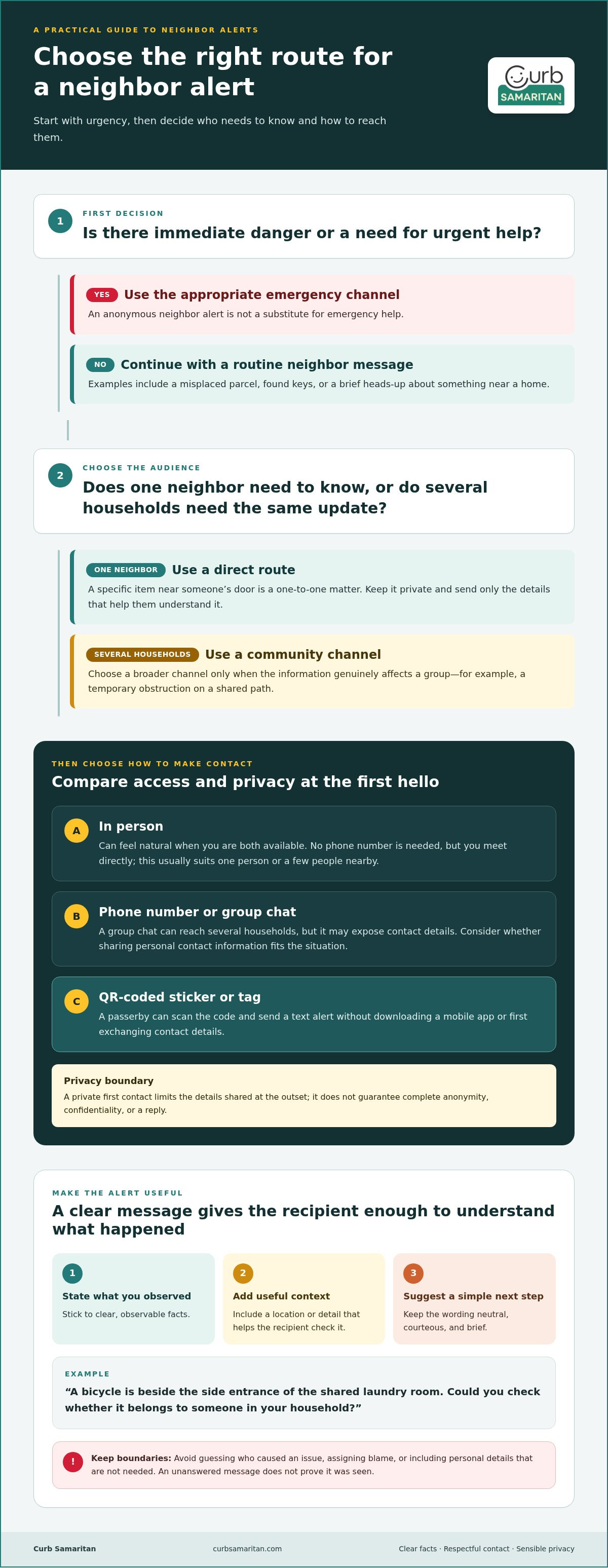
Sample: “A bicycle is beside the side entrance of the shared laundry room. Could you check whether it belongs to someone in your household?” The message gives a specific observation and location, then makes a polite request without adding unnecessary personal information.
When is a direct alert better than a group message?
Use a direct route when one person can address the issue, such as a note about an item left near their door. Choose a broader channel only if several neighbors need the same update, such as notice of a temporary obstruction on a shared path. Keep one-to-one matters private and group messages relevant to protect people’s attention and make communication more considerate.
For routine concerns, send the alert and allow the recipient time to respond. Don’t treat an unanswered message as proof that someone has seen it. If there’s immediate danger or someone needs urgent help, use the appropriate emergency service instead. Everyday messaging is not emergency response or security monitoring.
For a simple way to open a neighbor-to-neighbor message route, Curb Samaritan’s QR-coded stickers and tags let a passerby scan and send a text alert through a platform that doesn’t require a mobile app.
Anonymous Neighbor Contact Compared with Group Chats and Phone Numbers
Each contact method involves a different trade-off. A face-to-face conversation may feel natural, while a group chat can reach several households at once. Choose based on who needs the information, how you can reach them, and what personal details you’re comfortable sharing.
| Method | Ease of access | Personal-detail exposure | Audience size | Best suited to |
|---|---|---|---|---|
| In-person contact | Easy when you’re both available | No phone number needed, but you meet directly | Usually one person or a few people nearby | Quick conversations and familiar neighbors |
| Phone-number exchange | Convenient for direct follow-up | Each person shares a number | Usually one-to-one | Neighbors who want ongoing direct contact |
| Group chat | Convenient for members already in the chat | Contact details or profiles may be visible to group members, depending on the platform | Several people | Updates that genuinely concern the group |
| QR-enabled messaging | A passerby can scan a visible sticker or poster | Offers a message route without first exchanging phone numbers | Typically connects a sender with the intended recipient | Everyday alerts where a physical QR code is available |
What are the trade-offs of sharing a phone number or joining a group chat?
Sharing a number can make direct communication familiar and easy to continue, but it means giving someone your contact detail. A group chat can spread a useful update quickly, yet every extra message competes for attention. Members’ contact details or messages may also be visible more broadly within the group. Before sending an update or inviting someone into a chat, consider who actually needs the information.
Where can a QR-enabled message fit?
A QR code can provide a scan-to-message route when a sticker or poster is visible. Curb Samaritan’s QR-coded products let a passerby send a text alert through its messaging platform without downloading a mobile app or first exchanging personal contact details. The NTIA’s report on online households’ privacy and security concerns offers context for why some people prefer a more private first step.
For more on this option, see No-App QR Code Contact Stickers: How They Work and Protect Privacy. Match your communication route to the message, the recipient, and everyone’s comfort with sharing contact details. No channel is right for every neighbor or situation.
How to Make Anonymous Communication for Neighbors Respectful and Useful
A private route can make it easier to raise a small concern, but anonymity alone doesn’t create trust. Trust grows when a message is fair, relevant, and easy to understand. Before sending anonymous communication for neighbors, use this quick checklist:
- Assess urgency. Decide whether this is a routine heads-up or an immediate safety concern. A message or QR code isn’t an emergency response service.
- Choose a suitable channel. Contact one neighbor directly if the issue affects them; use a broader channel only if the information matters to the group.
- State what you know. Describe what you observed, where it happened, and a reasonable next step. Don’t present guesses as facts.
- Protect personal details. Include only information the recipient needs. Leave out names, routines, or details about people who aren’t involved.
How can neighbors build trust without revealing private details?
Keep the note specific and polite. “A package is beside the side entrance” gives someone a useful fact; a claim about who left it there adds speculation. Avoid identifying uninvolved people or guessing at anyone’s motives. If the messaging route allows a reply, make it clear that the recipient can ask a relevant follow-up. This leaves room to clarify without requiring personal details in the first message.
Allow time for a response. People may not see an alert right away, and a QR-based message can provide a way to contact the recipient, but it can’t ensure they’ll read it, reply, or fix the issue. Keep expectations modest and follow up only when doing so would genuinely help.
What should anonymous messages not be used for?
Don’t use neighbor messaging for surveillance, professional security monitoring, threats, discriminatory comments, repeated unwanted contact, or irrelevant complaints. A private channel is for helpful communication, not a way to pressure or target someone. If there’s immediate danger or someone needs urgent assistance, contact the appropriate emergency services instead of relying on a sticker or messaging platform.
For everyday neighbor alerts, a QR-coded sticker can give a passerby a route to send a text through Curb Samaritan’s messaging platform without a mobile app. Explore Curb Samaritan’s QR-coded stickers for neighbor communication as one practical way to make a helpful first message easier.
A QR-Based Option for Private, Everyday Neighbor Communication
A visible QR code can give neighbors a way to send an alert without first exchanging phone numbers. Curb Samaritan sells physical QR-coded stickers and tags for secure, anonymous text alerts. A passerby scans the code and uses the messaging platform to send a message without downloading a mobile app. This gives anonymous communication for neighbors a practical route for everyday situations, whether someone wants to pass along a useful heads-up or reach a resident.
The scan opens a messaging route to the owner. It doesn’t create an ongoing relationship or guarantee that every alert will receive a reply. A QR code makes initial contact easier, while a clear, considerate message helps make that contact useful. Each purchase includes lifetime access to the messaging platform without recurring subscription fees.
Which Curb Samaritan options suit shared community communication?
The Resident Sticker suits resident-facing communication. For a broader shared approach, neighbors can consider the Neighborhood Connect Sticker Bundle or QR Code Posters. Each provides a physical QR-code route for sending a message. Decide how the route will be shared, what it is intended for, and which kinds of alerts are appropriate.
How can neighbors explore a privacy-first communication setup?
Start with a simple shared understanding. Decide what belongs in an alert, what should go through another channel, and how people can reply or ask for context. Keep messages relevant and respectful. A QR-based route can make it easier to reach out without requiring an app or an initial exchange of personal contact details, but it isn’t emergency response and doesn’t guarantee a reply.
For more on the privacy choices behind these tools, read Anonymous Messaging for Neighbors: Privacy-First Guide. If a QR-code option suits your community, explore Curb Samaritan’s stickers, tags, and posters.
Make Neighborly Communication Easier to Begin
Good neighbor communication starts with a clear, considerate message and a channel that suits the situation. A private first contact can spare people from exchanging phone numbers, but it doesn’t promise complete anonymity, a reply, or immediate help. Keep routine alerts factual, share only what’s needed, and use emergency services for urgent danger.
Curb Samaritan’s physical QR-coded stickers and tags provide one practical way to support anonymous communication for neighbors. Passersby can connect with an owner through text alerts without a mobile app, and each purchase includes lifetime access to the messaging platform without recurring subscription fees.
Explore Curb Samaritan’s QR-coded stickers, tags, and posters to find a private way to make everyday neighbor communication easier to begin.
Frequently Asked Questions
Can neighbors communicate anonymously without sharing phone numbers?
Yes. Neighbors can use a messaging route that doesn’t require them to exchange phone numbers first. Curb Samaritan’s QR-coded stickers and tags let a passerby send an anonymous text alert to an owner through its messaging platform. This protects contact details during initial communication, but it doesn’t make every part of an exchange completely anonymous or confidential. Keep messages respectful and share only the information needed to explain the alert.
How can I alert a neighbor without knowing their contact information?
You can use a shared community channel or a visible QR-coded sticker or poster that opens a messaging route. With Curb Samaritan, a passerby scans the code and sends an alert through the platform without needing a mobile app or the owner’s phone number. Keep the note brief and specific, such as identifying an item or explaining where it was noticed. A message provides a way to reach out, not a guaranteed reply.
Is anonymous messaging for neighbors safe?
It can offer a more private first step by avoiding an immediate exchange of phone numbers, but no communication method guarantees complete anonymity or confidentiality. Curb Samaritan provides secure, anonymous text alerts through its QR-coded products. Whatever the channel, use good judgment: stick to relevant facts, avoid sharing sensitive personal details, and don’t use anonymous messages to threaten, target, or repeatedly contact someone.
Do neighbors need to download an app to scan a QR code?
No mobile app is required to use Curb Samaritan’s messaging platform. A passerby scans the QR code on a sticker or tag to access the route for sending a text alert. The code provides a way to reach the owner without first exchanging phone numbers. The sender still needs a device that can scan the code and access the messaging route, and a QR message isn’t a substitute for urgent assistance.
What should I include in an anonymous message to a neighbor?
Include what you observed, enough context to help the recipient understand it, and a polite next step. For example, say that an item is near a particular entrance and ask whether it belongs to someone in the household. Keep the wording neutral. Avoid accusations, guesses about motives, and personal information that isn’t needed. Clear, considerate messages make it easier for a neighbor to decide how to respond.
Can anonymous neighbor messaging replace a neighborhood emergency system?
No. Anonymous neighbor messaging isn’t an emergency response system and shouldn’t be relied on when there’s immediate danger. QR-coded stickers and tags provide a way to send everyday text alerts to an owner, but they don’t guarantee that a message will be read or answered quickly. For an emergency or immediate threat, contact the appropriate emergency services. Use neighbor messaging for routine alerts, such as sharing a relevant heads-up or reporting a found item.
Do QR communication stickers require a monthly subscription?
No. Curb Samaritan purchases include lifetime access to the messaging platform without recurring subscription fees. The stickers and tags create a QR-based route for passersby to send text alerts without requiring a mobile app. This gives neighbors a way to make initial contact without exchanging phone numbers. Use the route for appropriate everyday alerts, not emergencies or urgent assistance.