

How to Contact a Driver Anonymously: Safe, Private Options
What if you could alert a driver without sharing your name or phone number? Learning how to contact driver anonymously starts with one question: is this a routine heads-up or an urgent safety concern? A car blocking a driveway or lights left on may call for a private message. Dangerous driving needs a different response.
It’s understandable to want to reach someone who isn’t nearby while keeping your personal details private. This guide explains how to choose an appropriate option, write a clear message, and recognize when to contact emergency services or an authority instead. For everyday vehicle alerts, a Curb Samaritan Driver Sticker lets a passerby scan a QR code and send a secure, anonymous text alert without an app or sharing personal information.
You’ll also learn what details make a message useful, why a license plate lookup isn’t a reliable way to contact an owner, and how to distinguish neighborly communication from reporting a possible crime or immediate threat. The goal is to share a helpful alert while keeping privacy and safety in view.
Key Takeaways
- How to contact driver anonymously depends on whether you’re sharing a routine heads-up, reporting suspected crime, or responding to immediate danger.
- Compare notes, calls or texts, official reports, and QR-code alerts based on your privacy needs and whether you hope to get a reply.
- Make a vehicle alert useful by identifying the car, describing what you observed, and keeping the message neutral and brief.
- Use emergency services for an immediate safety threat rather than trying to reach the driver directly.
- A Driver Sticker gives passersby a private way to send a routine vehicle alert.
How to Contact a Driver Anonymously: First Decide What the Situation Needs
You notice a car with its lights on, a window open, or a position that’s blocking access. You want to help, but the driver isn’t nearby, and approaching them or sharing your phone number may feel uncomfortable. Before choosing how to contact driver anonymously, decide what kind of response the situation calls for.
Anonymous driver contact means passing a message to a vehicle’s owner without disclosing your personal contact information. It can work for an everyday heads-up when there’s no immediate threat. It isn’t the same as reporting dangerous behavior or suspected crime. A sticker or private message is not an emergency-response or law-enforcement channel, and shouldn’t replace one.
When a direct message is appropriate
A direct alert can suit a simple, visible issue: the headlights appear to be on, a window seems open, or a parked vehicle is obstructing a driveway. The driver may appreciate knowing, even if they decide there’s nothing to do. A brief, factual message lets them assess the situation without requiring you to confront them or make a formal complaint.
Keep the purpose modest. Share what you noticed, rather than assigning blame or trying to resolve a disagreement. For example, “A rear window looks open on the blue car parked beside the entrance” is more useful than speculating about why it’s open. If the driver is present and you feel safe, a polite word may work, but you don’t need to approach them. Choose a private alert if one is available and feels more comfortable.
Not every inconvenience calls for official action. A vehicle briefly parked awkwardly may need only a courteous heads-up. If the obstruction creates a hazard, prevents access, or continues, the appropriate next step depends on the circumstances. Keep routine communication separate from issues that call for an authority.
When to seek urgent or official help instead
If someone is in immediate danger, there’s an active emergency, or a collision needs urgent assistance, call 911. Don’t wait for a driver to see a message. A private alert can’t dispatch help, assess a scene, or take the place of emergency services.
For a non-emergency traffic concern or suspected criminal activity, use an appropriate official reporting route. The right contact can vary by jurisdiction and incident type, so an agency’s non-emergency guidance can help direct your report. Share what you observed accurately and distinguish firsthand details from assumptions.
If a driver is creating an immediate risk, don’t approach, follow, or confront them. Move to a safer place and contact emergency services. A direct alert is for a routine vehicle-related heads-up, not a way to intervene in dangerous behavior. Choosing the right channel helps protect your privacy while ensuring the concern reaches someone equipped to respond.
How Anonymous Driver Contact Methods Work, and What Each Reveals
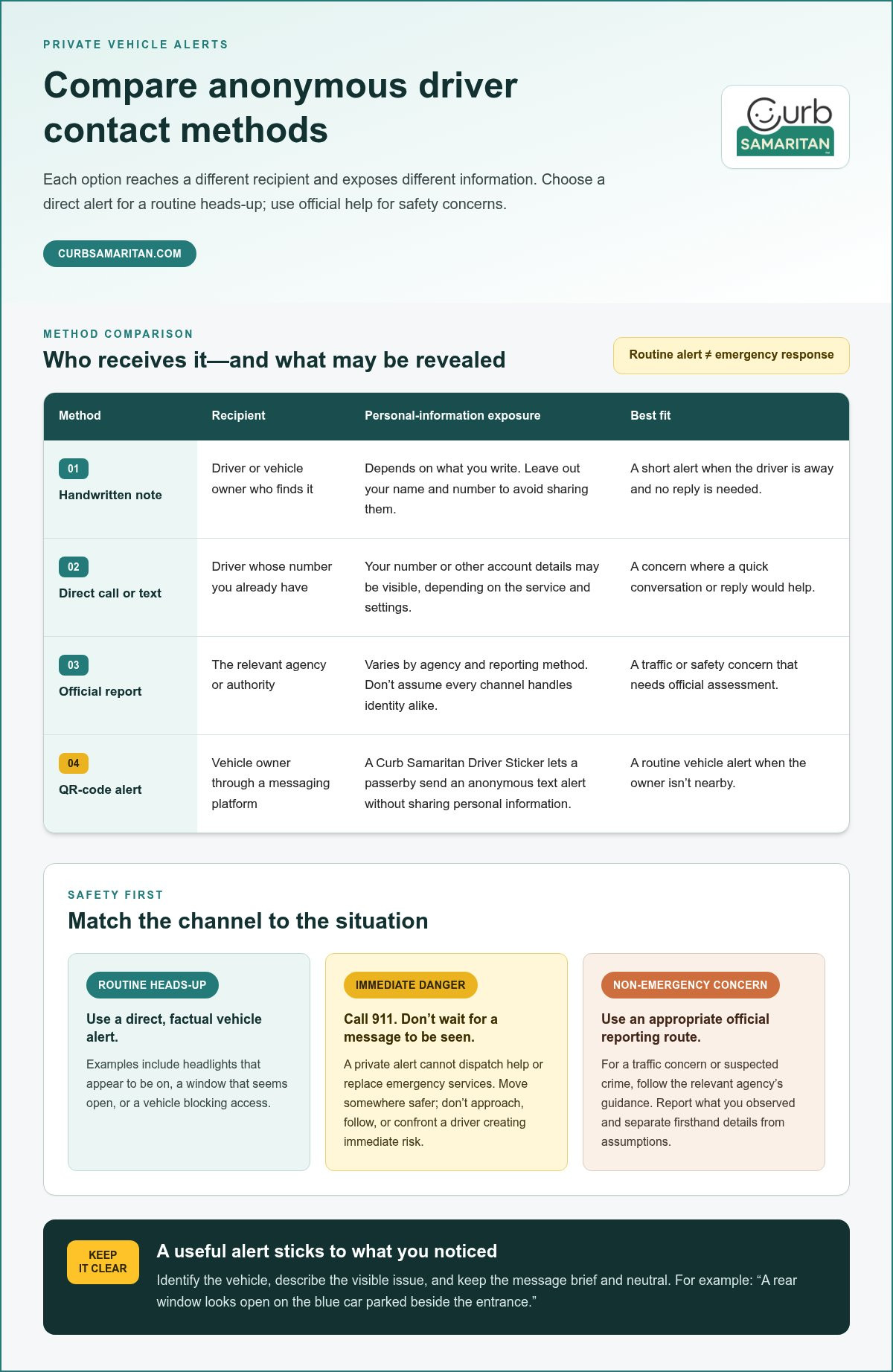
Once you know a direct alert is suitable, choose how to send it. Each method reaches a different recipient and exposes different information. A handwritten note can keep your phone number private, but it doesn’t support a reply. A direct text can invite a response, while also revealing the number you use. An official report goes to an agency, not straight to the driver.
| Method | Recipient | Personal-information exposure | Best-fit situation |
|---|---|---|---|
| Handwritten note | Driver or vehicle owner who finds it | Depends on what you write; omit your name and number to avoid sharing them | A short alert when the driver is away and no reply is needed |
| Direct call or text | Driver whose number you already have | Your number or other account details may be visible, depending on the service and settings | A concern where a quick conversation or reply would help |
| Official report | The relevant agency or authority | Varies by agency and reporting method; don’t assume every channel handles identity alike | A traffic or safety concern that needs official assessment |
| QR-code alert | Vehicle owner through a messaging platform | With a Curb Samaritan Driver Sticker, the passerby can send an anonymous text alert without sharing personal information | A routine vehicle alert when the owner isn’t nearby |
Notes and direct calls or texts
A note can be practical if the driver has stepped away and the message is simple, such as pointing out a window left open. Keep it brief and stick to what you observed. A note doesn’t give the driver a reply channel. Adding your phone number creates one, but also shares that personal detail. Include only what the driver needs to identify the vehicle and understand the alert. Leave out sensitive information about yourself or anyone else.
A call or text may feel more direct, but privacy depends on the service, its settings, and the information you provide. Don’t assume every call, text service, or reporting tool protects identity in the same way. If you don’t already have the driver’s number, trying to find their personal details may be less appropriate than choosing a method designed for sending an alert.
Official reports and QR-code alerts
Official channels are for concerns that need an authority’s review, not routine messages intended for a vehicle owner. For information about broader vehicle safety and reporting, NHTSA offers a federal resource; local agencies handle reports according to their own processes. Follow the specific channel’s instructions rather than assuming a report is anonymous or confidential.
A QR-code alert offers another route: a passerby scans the code on a Driver Sticker and sends the vehicle owner an anonymous text alert. The passerby doesn’t need an app or have to share personal information. It’s a direct-message option, not an emergency or law-enforcement channel. Vehicle owners who want to make everyday alerts easier to send privately can use a QR-coded Driver Sticker.
Which Anonymous Way to Contact a Driver Fits Your Situation?
The right choice depends on three things: how urgent the concern is, whether the driver is there, and whether a reply would help. No single contact method fits every situation. Use this guide to choose a channel suited to the concern, without turning a routine heads-up into a confrontation.
Immediate danger or active emergency: Call 911. Don’t rely on a sticker, note, or delayed message to get urgent help.
Suspected crime or non-emergency traffic concern: Report it through the appropriate authority’s process. Procedures vary by jurisdiction and by the nature of the concern.
Routine issue, driver away, no reply needed: A concise note may work if you’re comfortable leaving one. It passes along an observation but doesn’t create a reply channel.
Routine issue, driver away, reply could help: Use a visible QR contact option if the vehicle owner has placed one where it can be scanned. Otherwise, a note may be the practical choice.
Driver present, simple concern: If it feels safe and appropriate, share the observation calmly. If you’d rather not approach, choose another suitable direct-contact option.
For a simple alert about a parked vehicle
Keep the message grounded in what you can see: “The rear passenger window appears open” or “Your car is blocking the driveway entrance.” Avoid guessing why the vehicle is there or what the driver intended. If there’s a QR sticker in a visible, scannable spot, it offers a direct way to send an alert. Without one, a short note may be enough. Don’t touch, enter, or move someone else’s vehicle.
Consider whether you need a response. If not, a note can communicate the basic fact, though the owner won’t have a direct way to reply. If a reply might clarify the situation, a messaging channel may be more useful, but its privacy depends on the service. A QR sticker helps only when the vehicle owner has placed one where a passerby can scan it. It isn’t a way to find or track an owner who hasn’t chosen to use one.
For dangerous driving or an urgent concern
Don’t use a sticker or delayed message instead of urgent help. For immediate danger, call 911; don’t approach or follow the driver. If it’s safe, note relevant observations such as the vehicle’s description, location, direction of travel, and what you witnessed. Don’t put yourself at risk to gather details or record anything.
For suspected crime or a traffic concern that isn’t an emergency, use an appropriate reporting route. The correct agency and process can depend on the situation and jurisdiction. Share firsthand facts clearly, and don’t present assumptions as evidence. This keeps a private driver alert separate from an official report, so the concern reaches the channel suited to it.
How to Send an Anonymous Driver Alert That Is Clear and Useful
A useful alert is easy to understand and act on. Keep it calm, specific, and limited to what the driver needs to know. If you’re deciding how to contact driver anonymously, use this simple sequence:
- Identify the vehicle. Include a make, color, or location only if needed to help the driver recognize which car you mean.
- State what you observed. Describe the visible issue without guessing at the cause or the driver’s intentions.
- Add helpful context. Include a nearby landmark or parking area if it helps the driver find the vehicle. Leave out unrelated details.
What to include in a helpful alert
Make the message factual and brief. For example: “Your blue sedan is parked near the east entrance. The headlights appear to be on.” This identifies the car, describes what you noticed, and gives a useful location without blame or speculation. If the vehicle is already easy to identify, skip extra details. The goal is to help the intended driver recognize the alert, not to collect information about them.
Keep directions simple. “Beside the east entrance” may be enough; there’s no need to share your own location or explain why you’re there. A neutral tone matters too. “Your window appears open” is more helpful than “You left your car unsecured,” which assumes intent and may sound accusatory.
What to leave out, and what to do afterward
Protect your privacy by leaving out your home address, daily schedule, workplace, and other personal details that aren’t needed to explain the issue. Don’t include threats, accusations, requests for the driver’s private information, or photos that reveal unnecessary details about people or their surroundings. If a photo seems useful, consider whether the message can communicate the concern clearly without it.
Once you’ve sent the alert, give the driver room to respond or take action. Don’t repeatedly message or confront them if they don’t reply. They may not see the message, or they may choose not to respond. If the concern becomes urgent or suggests a crime, use the appropriate emergency or reporting channel instead of continuing a private exchange.
Before sending, check three things: does the message identify the right vehicle, describe only what you observed, and avoid exposing personal information? Send it only when you can do so safely. Never compose or send a message while driving. If the vehicle is moving or it’s unsafe to stop and communicate, wait until you’re safely parked or leave the matter to the appropriate authority.
For vehicle owners who want passersby to have a private way to share a routine alert, a QR-coded Driver Sticker provides a simple contact path. Explore the Driver Sticker as an option for making everyday vehicle alerts easier to send.
Contact a Driver Anonymously With a Curb Samaritan Driver Sticker
For a routine vehicle concern, a direct alert can be a considerate alternative to approaching the driver or leaving a note with your number. A Curb Samaritan Driver Sticker gives vehicle owners a way to receive that kind of message: a passerby scans the sticker’s QR code and sends an anonymous text alert to the vehicle owner.
What the Driver Sticker makes easier
The QR code gives a passerby a visible way to share a simple heads-up, such as noticing that a window appears open or that a vehicle may be obstructing access. The passerby doesn’t need a mobile app or have to share personal information to send an alert. This can make everyday communication more approachable for someone who wants to help while keeping their contact details private.
The message is an alert, not a promise of action. The vehicle owner may not see or respond to it, so senders shouldn’t rely on a sticker for urgent help. It also isn’t GPS tracking, professional monitoring, or a law-enforcement channel. If the situation involves immediate danger, contact emergency services; a private vehicle alert is for non-emergency communication.
For owners, the Driver Sticker offers a way for passersby to reach them about their vehicle without exchanging phone numbers face to face. A one-time purchase includes lifetime access to the messaging platform, with no recurring subscription fees. The sticker doesn’t turn every parking concern into a conversation, but it gives someone a simple way to send a helpful message when the owner isn’t nearby.
A private alert can make neighborly help simpler
A passerby might spot a detail the owner hasn’t noticed and choose to share it through the sticker rather than leave a handwritten note or try to find the owner. This keeps the interaction focused on the vehicle and the immediate issue, without requiring the sender to provide personal contact information. The owner can decide what to do with the alert.
If you’d like to understand the broader idea behind QR-based contact options, the guide No-App QR Code Contact Stickers: How They Work and Protect Privacy covers how they can support private messages. The Driver Sticker gives vehicle owners a way for passersby to send an alert directly. For everyday vehicle concerns, consider whether that simple contact path suits how you’d like to hear from your community.
Make Everyday Help Easier to Offer
A helpful message is easier to send when there’s a clear, comfortable way to reach the person who needs it. If you own a vehicle, think ahead about how you’d like someone to flag a small issue without approaching you. A simple plan can help a passerby feel more at ease and keep an ordinary concern from becoming an awkward encounter.
If you’re considering how to contact driver anonymously, choose an option suited to the kind of communication you want to make possible. Curb Samaritan’s Driver Sticker gives passersby a QR-coded way to send an anonymous text alert without an app or sharing personal information. A one-time purchase includes lifetime access to the messaging platform.
If that would be useful for your vehicle, explore the Curb Samaritan Driver Sticker. A clear contact path can make everyday neighborly help feel more natural.
Frequently Asked Questions
How can I contact a driver anonymously?
For a routine issue, choose a method that doesn’t reveal your contact details, such as an unsigned note or a QR contact sticker already on the vehicle. The best way to contact driver anonymously depends on whether a reply would help and whether the vehicle is accessible. If there’s immediate danger, contact emergency services instead of relying on a message to reach the driver.
Can I contact a driver without sharing my phone number?
Yes. You can leave a short note without signing it or adding a number, though the driver won’t be able to reply directly. If the vehicle has a QR alert sticker, you can use that instead of writing down your contact information. Avoid calling or texting from your personal phone if you don’t want the recipient to see your number. What they can see may depend on the service and settings.
What should I write in an anonymous message to a driver?
Identify the vehicle only as much as needed, describe what you observed, and include a location detail if it helps the driver find it. For example: “The gray hatchback near the far end of the lot has its rear hatch open.” Keep the wording neutral. Don’t guess why it happened, accuse the driver, or include unrelated details about yourself or other people.
Can a QR code help me send an alert to a driver?
Yes, if the vehicle owner has placed a QR code sticker designed for direct alerts where it can be scanned. The code can lead to a way to message the owner without approaching them. Not every QR code is an alert tool, though. Before submitting anything, check that the page is meant for contacting the vehicle owner and avoid entering personal details you don’t want to share.
What should I do if a driver is creating immediate danger?
Call 911 if someone faces immediate danger or there’s an active emergency. Don’t try to get the driver’s attention, follow the vehicle, or take photos if doing so could put you at risk. Move to a safer place first. If you can safely remember details, note the vehicle’s description, location, and direction of travel for responders. Never use your phone while driving to report it.
Can I anonymously report dangerous driving?
Some law enforcement agencies offer anonymous tip lines or online reporting options, but available channels and privacy practices vary. Follow the specific agency’s or reporting service’s instructions, and don’t assume every form or phone line keeps your identity anonymous. If the driving creates an immediate threat, call 911 rather than waiting to submit a non-emergency report or tip.
Does a driver alert sticker track the vehicle?
No. Curb Samaritan’s Driver Sticker is a way to send an alert to a vehicle owner, not a GPS tracker. It doesn’t provide a way to locate or follow a vehicle. A passerby uses the sticker’s QR code to send a message, so treat it as a communication option for routine vehicle concerns, not a tool for tracking or responding to emergencies.