

Message a Car Owner Blocking Your Driveway Politely
A car can block your driveway even if it only partly crosses the opening. In most cities, a vehicle parked partly across a driveway may receive a ticket, even if it blocks the opening by only a foot. In the United States, blocking a driveway is generally illegal, but local rules vary. If you need to message the car owner who blocked your driveway, a calm note or neighborly check-in can be a good first step.
Being unable to get in or out is frustrating, especially when you don’t know whose car it is. You can address the problem clearly without turning a parking mistake into a bigger conflict.
This guide explains what may count as a blocked driveway, how to ask nearby neighbors about the car, and what to write in a polite note or message. It also covers what to do if you can’t reach the driver, so you can choose a practical next step and keep the interaction respectful.
Key Takeaways
- A car may obstruct your driveway even when it only partly blocks the opening; local parking rules determine what action can follow.
- Ask nearby neighbors calmly if they recognize the vehicle, and keep the conversation focused on finding its owner.
- A clear, courteous note can explain the access problem and ask the driver to avoid blocking the driveway again.
- Skip confrontation, public shaming, and touching or damaging the vehicle; these actions can make a simple parking problem worse.
- Use a brief, respectful text that explains the issue and gives the owner an easy way to move the car or respond.
1. What is considered blocking a driveway?
A vehicle blocks a driveway when it obstructs access through the entrance, whether it covers the opening partly or completely. A car across the opening can prevent someone from entering or leaving, even if part of the driveway remains clear. By contrast, a vehicle parked on the public street in front of a home is usually allowed if it doesn’t obstruct the driveway or violate another local parking rule.
Local rules define where parking is allowed. California Vehicle Code § 22500(e) prohibits parking in front of a public or private driveway. Florida Statute § 316.1945 also prohibits parking in front of a public or private driveway, according to the Florida Legislature. The same statute prohibits parking within 20 feet of a crosswalk at an intersection and within 30 feet of a traffic signal or stop sign, according to the Florida Legislature. Those restrictions are separate from blocking a driveway, so note the vehicle’s exact position.
In most cities, a vehicle parked partly across a driveway opening can receive a ticket, even if it blocks the opening by only a foot. Some cities set a minimum distance from the edge of a driveway. Florida’s base fine for a nonmoving violation under Florida Statute § 318.18 starts at $30, according to the Florida Legislature. That figure is not necessarily the penalty for every driveway violation; the cited offense and local rules matter.
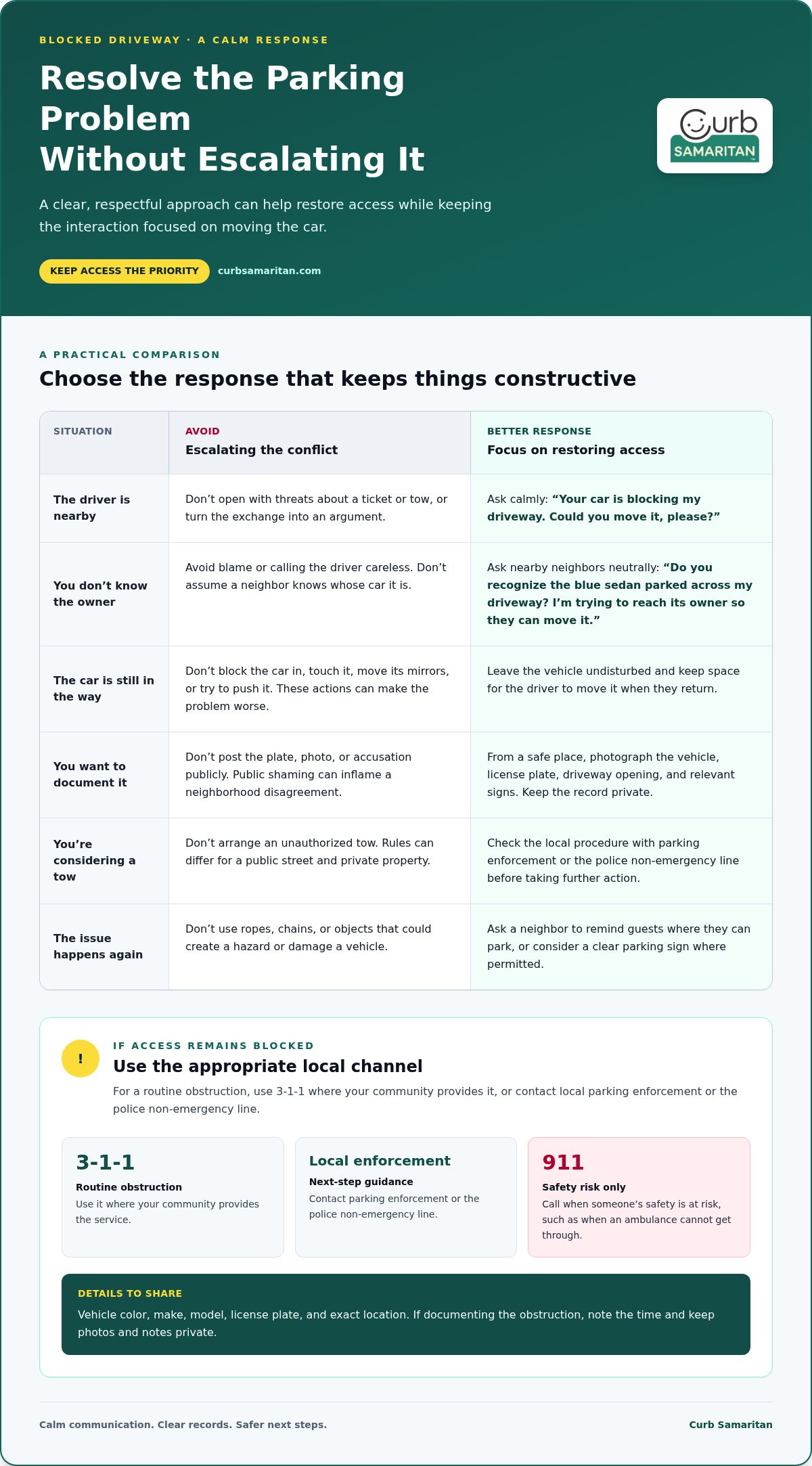
If the car owner refuses to move the vehicle, don’t block it in, touch it, or argue. Contact local parking enforcement or the police non-emergency line for the next step. For a routine obstruction, use 3-1-1 where your community provides it. Share the vehicle’s color, make, model, license plate, and exact location. Call 911 only when someone’s safety is at risk, such as when an ambulance cannot get through.
Towing depends on whether the car is on a public street or private property. In many cities, a private tow from a public street requires a ticket or police approval. Florida Statute § 715.07 governs towing vehicles from private property. Don’t arrange an unauthorized tow; local procedures determine who can authorize removal. When towing is authorized, use a licensed and insured towing service.
Look for visible contact information without entering the vehicle or handling personal belongings. If there’s no note, ask nearby neighbors whether they recognize the car. To document the obstruction, photograph the vehicle, license plate, driveway opening, and relevant signs from a safe place. Record the time and any damage, and keep the photos and notes private in case you need to make a report.
2. Actions to avoid, including confrontation and vandalism
A blocked driveway can feel personal, especially when you’re late or unable to leave. But damaging the vehicle, shouting, or blocking it in can turn a parking problem into a larger dispute. Focus on restoring access. A calm message or a request through nearby neighbors gives the owner a chance to move the car without a public argument.
Don’t scratch, mark, or otherwise damage the vehicle. Vandalism is illegal and can lead to criminal charges. Avoid touching the car, moving its mirrors, or trying to push it out of the driveway. Even a small mark or dent can shift attention from the obstruction to damage claims. Instead, take a photo from a safe place and leave the vehicle undisturbed.
Don’t park behind the car to force a conversation. Blocking it in can escalate the situation and make an amicable resolution harder. If a visitor has left a car across your driveway, leave space for them to move it when they return. If they’re nearby, say calmly: “Your car is blocking my driveway. Could you move it, please?” Don’t open with threats about a ticket or tow.
Avoid public shaming, too. Posting a plate number, photo, or accusation on social media can inflame a neighborhood disagreement and potentially raise defamation concerns. Keep your record private: note the time, location, and what happened, then share relevant details with parking enforcement if needed. A private record is more useful than a heated post that draws in people who weren’t there.
Don’t arrange a tow just because the driveway is blocked. Towing from a public street may require a ticket or police approval, while towing from private property follows rules that vary by jurisdiction. An unauthorized removal can create legal problems or damage claims. Contact local parking enforcement or the police non-emergency line for the appropriate next step. If the vehicle creates an immediate safety risk, such as preventing an ambulance from reaching someone, call 911.
For recurring issues, focus on prevention rather than retaliation. Ask a neighbor to remind guests where they can park, or install a clear “No Parking” or “Do Not Block Driveway” sign where permitted. A sign can communicate the request before another driver stops. Don’t place ropes, chains, or objects where they could create a hazard or damage a vehicle.
If a passerby needs a discreet way to contact a driver, private driver messaging can help them share an alert without exchanging personal details. It’s a calmer alternative to confronting someone in the street, but it doesn’t replace parking enforcement when access remains blocked.
3. Contacting neighbors to identify the car owner
Start with the homes closest to the blocked driveway, since residents may recognize a visitor’s car. Knock or send a brief message through a neighborhood group you already belong to. Describe the car by its color, make, and model, then ask whether anyone knows the owner. Focus on identifying the driver and reopening access, not assigning blame.
A neutral question makes it easier for a neighbor to help. Try: “Do you recognize the blue sedan parked across my driveway? I’m trying to reach its owner so they can move it.” Avoid calling the driver careless or saying they broke the law before you know the local rules. The exact restriction depends on where the vehicle is parked.
If a neighbor identifies the driver, ask them to pass along a simple request rather than sharing the person’s private number without permission. For example: “Your car is blocking access. Could you move it when you can?” This gives the owner a chance to respond directly and helps resolve the problem without an unexpected confrontation.
When asking nearby residents, share only the details needed to identify the car: its location, color, make, model, and license plate. Don’t post the plate publicly or circulate a photo beyond people who can help. The Driver’s Privacy Protection Act limits who may obtain vehicle-owner details from DMV records, so don’t use a plate to seek private information through unofficial channels.
If no neighbor recognizes the vehicle, leave a factual note on the windshield or use the local reporting route for a blocked driveway. In New York City, a report should include the vehicle’s color, make, model, and license plate number. Elsewhere, local parking enforcement or a 3-1-1 service may take reports. Use the non-emergency option for a parking obstruction; call 911 only if someone’s safety is at risk.
Keep the conversation with neighbors short and calm, especially if the car owner appears while you’re asking around. Explain what access is blocked, ask for help reaching the driver, and step away if tempers rise. Don’t surround the vehicle or demand personal details. If the owner refuses to move it, stop trying to persuade them and use the appropriate local reporting process.
For a recurring issue, privately record when the vehicle is parked and which neighbors you asked. A clear pattern can help explain the problem if you report it later. Share observations, not assumptions: “The driveway was obstructed when I returned” is more useful than accusing a specific neighbor without evidence. Keep the focus on a practical resolution.
4. Leaving a polite note for the car owner
A short note can tell the driver what happened without starting a face-to-face argument. Keep it factual, polite, and easy to understand. Explain that the vehicle is blocking your driveway and ask the owner not to park there again. Avoid insults, threats, or claims about a ticket, since parking rules and enforcement practices vary by location.
Write the message before approaching the car. Include only what the driver needs to know: the blocked access, your request, and a courteous closing. For example: “Your car is blocking my driveway, so I can’t get in or out. Please avoid parking across the entrance next time. Thank you.” This makes the problem and request clear without accusing the owner of acting deliberately.
Use these simple steps to keep the note useful:
- Address the driver neutrally, such as “Hello, driver” or “Hi.”
- Describe the specific issue, such as “The car is across my driveway.”
- Make one clear request, such as “Please leave the driveway opening clear.”
- End politely, without adding a threat about towing or a ticket.
If you know the vehicle belongs to a neighbor, make the wording more personal: “Hi, I think this may be your car. It’s blocking my driveway, and I need access. Could you please move it and leave the opening clear in future? Thanks.” This acknowledges that you may be mistaken while still asking for the car to be moved.
Keep identifying details to a minimum. You usually don’t need to write the license plate number on a note left on the vehicle. Don’t include your full schedule, phone number, or other personal details. If you want a reply, offer a way to contact you only if you’re comfortable sharing it.
Place the note where the driver can see it without obstructing their view or damaging the vehicle. Don’t write on the car, wedge anything into a door, or attach the message with material that could leave marks. A loose note under the windshield wiper is a familiar option. Make sure it remains visible until the owner returns.
For a recurring blockage, make the note clearer, not harsher. You might add: “This is a private driveway, and access needs to stay clear.” Privately record the date and what happened. If a polite request doesn’t resolve the problem, use local parking enforcement instead of escalating the message or confronting the driver on the street.
5. What should I text a car owner who is blocking my driveway?
Keep your first text calm, specific, and focused on moving the car. Identify yourself, describe the blocked access, and make one clear request. For example: “Hi, this is your neighbor beside the blue sedan. Your car is blocking my driveway. Could you move it, please? Thanks.” A friendly opening helps the owner understand the issue without feeling accused.
If you don’t know the driver, don’t guess who owns the vehicle. You could write: “Hello, I’m trying to reach the owner of the gray SUV across my driveway. I can’t get in or out. Please move it when you see this.” Describe the car accurately. Don’t add a license plate to a group text unless it’s needed to identify the vehicle.
To message a car owner blocking your driveway effectively, include the location, the impact, and a clear request. “Your car is across the driveway” identifies the problem. “I can’t leave” explains its effect. “Could you move it, please?” says what would help. Leave out unrelated complaints about earlier parking or the driver’s character. A focused text is easier to understand and answer.
If the owner replies defensively, don’t argue by text about whether the parking is illegal. Keep your response brief: “I understand this may have been accidental. I need the driveway clear, so please move the car.” A measured reply keeps the exchange practical. Don’t send repeated messages, threats, or insults while waiting for a response.
If a neighbor has blocked access before, acknowledge the immediate solution and make a courteous request for next time: “Thanks for moving the car today. Please leave the driveway entrance clear in future.” If the problem continues, privately record the dates and circumstances instead of turning each exchange into a longer dispute.
If you need to message the car owner blocking your driveway again, keep the follow-up short and specific. For example: “I’m checking in because the car is still blocking the entrance. Please move it so I can access the driveway.” If you can’t reach the driver directly, ask a nearby neighbor to pass along the request. Don’t share someone’s phone number without permission.
Texting can help when you have a safe, private way to contact the owner. If they refuse to move the vehicle, stop debating and use the local parking-enforcement or non-emergency reporting process. Keep the messages and your notes about the incident. If someone’s safety is at risk, such as an ambulance being unable to reach a person, call 911 rather than waiting for a text reply.
Curb Samaritan: Driver Sticker
Curb Samaritan’s Driver Sticker gives passersby a simple way to alert a vehicle owner when a car blocks access. They scan its QR code to send a secure, anonymous text message, without an app or sharing personal information. It can help when the driver is away and a polite note or neighbor check-in might resolve the situation.
The sticker provides a direct way to communicate, but it doesn’t replace local parking enforcement if a vehicle remains in the way. It’s designed for everyday alerts, from a blocked driveway to another issue that needs the driver’s attention.
If you want people to have a clearer way to reach you about your vehicle, visit Curb Samaritan to learn about the Driver Sticker.
Make the next interaction easier
A blocked driveway can lead to a neighborly conversation rather than an ongoing dispute. If you need to message a car owner blocking your driveway, keep the request direct and respectful. For future situations, a simple way to contact a vehicle owner can spare neighbors the guesswork and help an alert reach the right person.
Curb Samaritan offers a Driver Sticker for vehicle messages, a Resident Sticker for home-related contact, and a Found Sticker for items that need to find their owner. Each gives people a way to send an alert without an app or sharing personal information.
If you’d like to explore a practical way to make those connections easier, contact Curb Samaritan. A thoughtful message can help make shared streets and neighborhoods more considerate for everyone.
Frequently Asked Questions
What is considered blocking a driveway?
A vehicle blocks a driveway when it prevents someone from using the entrance or exit, even if it covers only part of the opening. For example, a car angled across the curb cut may leave too little room to turn through safely. Note whether the obstruction affects entry, exit, or both. This practical detail helps distinguish a blocked driveway from a vehicle parked nearby.
Is it illegal to park in front of someone’s driveway?
Generally, parking in front of a public or private driveway is prohibited, although local rules govern enforcement. California Vehicle Code § 22500(e) prohibits parking in front of a public or private driveway. Florida Statute § 316.1945 does too, according to the Florida Legislature. If a vehicle is near the entrance rather than in front of it, other local parking restrictions may apply. Describe its position accurately when reporting it.
Does Anyone “Own” the Street Parking in Front of Their House?
No. A resident doesn’t ordinarily own a public curbside parking space just because it’s outside their home. A parked car may be inconvenient without violating a parking rule. For example, a vehicle along the curb that leaves the driveway entrance clear is different from one across the opening. Focus on the actual obstruction and applicable parking restrictions, rather than assuming the space belongs to the nearest homeowner.
What details should I include in a message about a blocked driveway?
Include a clear vehicle description, its location, the access problem, and a direct request. For example: “Hi, the white SUV beside the mailbox is blocking my driveway, and I can’t get out. Could you move it, please?” If you need to message a car owner blocking your driveway, stick to observable facts and a respectful tone. Avoid accusations, personal details, and unrelated complaints.
How can I politely ask someone to move their car from my driveway?
Start with a greeting, explain the immediate problem, and ask plainly for the car to be moved. You could text: “Hello, your car is across my driveway, and I need to leave. Could you please move it? Thank you.” If you’re unsure who owns the vehicle, say so rather than making an accusation. One calm, direct request keeps the exchange focused on access.
What should I do if I can’t identify or contact the car owner?
Ask nearby neighbors whether they recognize the vehicle, then report the obstruction through the local non-emergency channel if you still can’t reach its owner. Give the vehicle’s location, color, make, model, and license plate. Some communities use 3-1-1 for parking reports. DMV owner information is restricted by the Driver’s Privacy Protection Act, so don’t seek private details through unofficial methods.
Who should I call when a car blocks my driveway: police, parking enforcement, or towing?
For a routine blockage, contact local parking enforcement, a 3-1-1 service where available, or the police non-emergency line. Provide the exact location and vehicle details. Call 911 only when there’s an immediate safety risk, such as an ambulance being unable to reach someone. Don’t start with a tow company; some cities require a ticket or police approval before a vehicle can be towed from a public street.
Can I have a car towed for blocking my driveway, and what rules apply?
Possibly, but the rules depend on whether the car is on a public street or private property and who can authorize removal. In many cities, towing from a public street privately requires a ticket or police approval. Florida Statute § 715.07 governs towing vehicles from private property. Before arranging a tow, establish that removal is authorized and follow the procedures that apply to that location.