

Privacy Pet Tags for Dogs: Prices and Engraving Options
A dog’s ID tag should make it easy for a finder to reach you without displaying more personal information than you’re comfortable sharing. Privacy pet tags for dogs can keep the message simple: include a useful way to contact you, then choose a tag’s price and design based on its material, shape, and engraving options.
It’s natural to want a tag that is private, durable, and easy to read. The right choice balances those needs so a kind stranger can act if your dog wanders off.
This guide covers what to put on a tag, how prices can vary, and what to consider when choosing materials, shapes, and colors. It also explains how QR-enabled tags give a finder another way to contact a pet’s owner while keeping personal details private.
Key Takeaways
- Keep engraved details brief and readable, and choose contact information that helps a finder reach you.
- Compare tag prices by construction and features, rather than assuming every shape or engraving option costs the same.
- Match a tag’s material, size, and attachment style to your dog’s everyday routine.
- Choose a shape and color that make the tag easy to spot and the engraving easy to read.
- Consider QR-enabled People & Pet tags if you want a finder to send you an anonymous text alert without sharing personal information.
Deep engraving and contact details
A privacy-focused tag gives a finder a way to contact you without displaying every personal detail. A GPS tracker helps locate a dog, while a microchip identifies a pet through a separate lookup process. An engraved tag is visible on the collar and can provide immediate instructions.
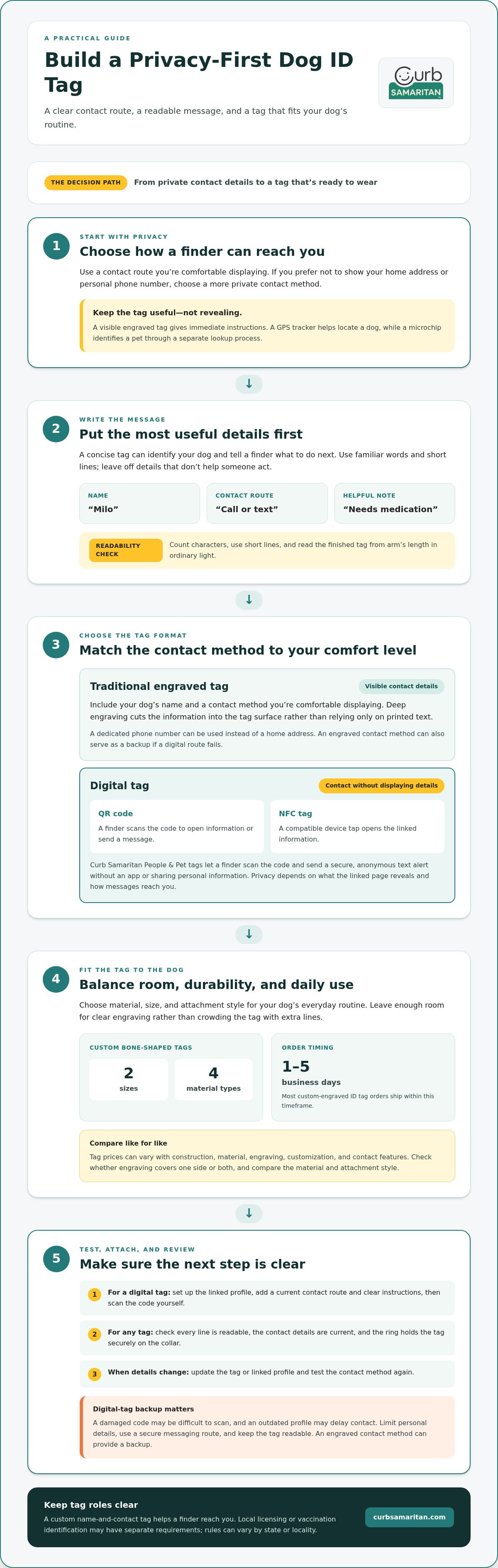
If you prefer not to display your home address or personal phone number, choose a tag with a more private contact route. A QR-enabled tag can let a finder send a message without showing those details. Keep the instruction short, such as “Scan to contact my family.”
A QR code opens information when scanned; an NFC tag works with a compatible device tap. Privacy depends on what the linked page reveals and how messages reach you. Curb Samaritan’s People & Pet tags let a finder scan the code and send a secure, anonymous text alert, without an app or sharing personal information.
For a traditional engraved tag, include your dog’s name and a contact method you’re comfortable displaying. For example, use a dedicated phone number rather than your home address. Add a brief note such as “Needs medication” only if it gives a finder useful guidance.
For a digital tag, set up the linked profile before attaching it to the collar. Add a current contact route and clear instructions, then scan the code yourself. Update the profile when your contact details or care notes change. A test scan can catch an outdated link or unclear message.
Digital tags have practical limitations: a damaged code may be difficult to scan, and an outdated profile may delay contact. Limit personal details, use a secure messaging route, and keep the tag readable. An engraved contact method can provide a backup if the digital route fails.
Make engraving easy to read
Engraving should be legible at a glance. Use short lines, familiar words, and strong contrast between the letters and tag surface. Before ordering, count the characters in each line and remove details that don’t help a finder act. “Call or text,” for example, is clearer than a long explanation.
Deep engraving cuts information into the tag surface instead of relying only on printed text. Ask for your dog’s name and contact method to be engraved clearly, then check that the finished lines are readable. A finder should understand the next step without having to study tiny text.
Custom bone-shaped tags are available in 2 sizes and 4 material types. Most custom-engraved ID tag orders ship within 1-5 business days. Choose a size that leaves room for readable details, not one that encourages crowded lines. A smaller tag can still work when the message is concise.
Before attaching the tag, read every engraved line in ordinary light. Check that the contact details are current and the ring holds the tag securely on the collar. A clear name, a usable contact route, and one helpful note make the tag easier for a neighbor to act on.
Custom pet identification information
Choose tag details that help someone identify your dog and contact you. In the United States, identification-tag requirements can depend on local rules, so distinguish a general ID tag from any local licensing or vaccination identification requirements.
Custom Identification Details
A custom tag can show your dog’s name, a contact method, and a brief care note. For example, “Milo,” a phone number, and “Needs daily medication” give a finder clear next steps. Include what a stranger needs to help, not everything you know about your pet.
Review each line before ordering. Put the most useful information first, such as the contact route, then add a name or short note if space allows. If you prefer not to display your personal number, choose a contact method you’re comfortable sharing. Leave off your home address if a finder can reach you another way.
Some details belong on the tag; others fit better in a linked profile. A tag has limited space, so reserve it for quick instructions such as “Call my family.” A digital profile can hold fuller details, including a second contact or care information. Keep the profile current whenever your contact method changes.
Use plain language and familiar words. “Deaf” or “Needs medication” can help a finder understand an immediate need. Avoid long explanations, decorative wording, and details that don’t change what someone should do. Read the tag from arm’s length before attaching it to make sure every line is clear.
Identification Tag Requirements
There isn’t one identification-tag requirement that applies uniformly to every dog owner across the United States. Rules may vary by state or locality, so check the requirements where your dog lives or travels. A general ID tag doesn’t necessarily replace separate local licensing or vaccination identification.
Keep the purpose of each item clear. A custom name-and-contact tag helps a finder reach you; a license tag or vaccination identifier serves a separate local purpose. If your dog wears multiple tags, attach them securely and arrange them so key details remain readable. For example, position the everyday contact tag where another tag won’t cover it.
Build in a simple review routine. When you move, change phone numbers, or update your dog’s care needs, inspect every tag and linked detail. Replace anything that’s outdated, then test the contact method yourself. A current tag gives someone a practical way to help, while concise details protect privacy and reduce confusion.
Pet tag prices
A dog tag’s price depends on what it includes. A plain engraved tag and a digital tag serve different needs. Material, engraving, customization, and contact features can all affect the price. Compare the same features across options rather than judging by appearance alone. Check, for example, whether the price covers engraving on one side or both, then compare the material and attachment style.
Engraving choices can affect the work involved. A short name and phone number take less space than several lines of custom text. A two-sided design may fit more information, while a compact tag calls for careful editing. If a listing mentions deep engraving, look for details about how the information is marked. Read the description closely to see which custom choices are included.
Digital features also set tags apart. A QR code can give a finder a way to reach an owner without displaying contact details directly. That differs from an ordinary engraved tag, where the information is visible on its surface. Compare the purpose before the price: digital messaging suits owners who want privacy, while direct engraving suits those who want visible details.
- Material: Compare the listed material and finish, such as aluminum or plastic.
- Engraving: Check whether custom text, both sides, or added symbols are included.
- Design: Note whether shape or color choices change the selected option.
- Contact method: Separate visible phone details from QR-linked messaging features.
- Attachment: Review whether the listing describes a ring, buckle, or slide-on fit.
Look for information about scratches and wear, then consider how your dog wears a tag. One that rubs against another metal tag may show wear differently from one worn alone. Check the stated material and finish instead of making assumptions from a photo. A clear product description makes it easier to compare options.
Use a simple comparison before choosing. First, list the details your dog needs. Next, decide whether to engrave them or share them digitally. Then compare materials, customization, and attachment. A dog whose owner wants privacy, for example, may need a different contact method from one whose tag displays a phone number. The best value comes from features that solve your actual need, not extras you won’t use.
Three listed options show how prices can differ by tag style. Compare each format and contact approach alongside the price, rather than treating all tags as interchangeable.
Before choosing, compare the listing details that matter for your dog: what text or digital information the tag supports, how it attaches, and whether customization is included. Product names identify different styles but don’t explain every feature. Read the full descriptions and decide whether a buckle format, double-sided design, or QR code meets a real need. A higher price makes sense when the corresponding feature fits your requirements.
Tag durability and weather resistance
A durable tag needs to stay readable through your dog’s routine. A city dog may brush a tag against a leash clip, while a hiking dog may pick up mud. Consider those conditions when choosing a finish. Product descriptions can help you compare materials, construction, and care instructions. Don’t assume a polished surface or thick appearance proves durability. Look for clear details about how the tag is made and maintained.
Weather exposure also depends on your dog’s routine. One dog may return from a rainy walk with a wet collar, while another spends time in dusty parks. Check whether the tag description addresses moisture and cleaning, and follow any care instructions. Don’t assume “weather resistant” means suitable for every activity or exposure. Pay attention to the tag’s stated limits.
Engraving needs attention too. Check the lettering before attaching the tag. If a name or contact detail looks faint, crowded, or hard to read, a finder may struggle to use it. After muddy walks, wipe the surface with a soft cloth and inspect the text. Avoid harsh cleaners unless the care instructions allow them.
The attachment can affect wear. A loose split ring may let the tag swing and knock against another metal tag. A crowded collar can also hide the engraved side. Check that the ring closes securely and the tag hangs freely. Move it away from a bulky leash clip if the clip blocks the text.
- Inspect the surface: Look for cracks, bends, sharp edges, or worn lettering.
- Check the attachment: Make sure rings close fully and tags stay on the collar.
- Read the care notes: Follow the stated cleaning and exposure guidance.
- Test readability: Hold the tag naturally and confirm its details remain clear.
Make inspection part of an existing routine. When you remove your dog’s collar for cleaning, examine the tag and attachment. Look for a bent ring, a loose fitting, or details obscured by dirt. If the tag has a digital code, make sure its surface is clear enough to scan. A clean, readable code gives a finder a practical next step.
Choose a tag based on your dog’s habits, not appearance alone. A lightweight tag may suit a small collar, while an active dog may need a secure attachment that stays in place. Compare the stated construction and care guidance, then check the tag after walks, especially if your dog swims, rolls in dirt, or wears multiple tags. This simple habit can catch wear before key information becomes hard to read.
Tag shapes, colors, and designs
Choose a shape with enough room for readable details. A round tag has a familiar outline, while a bone shape adds a playful look. Heart and paw designs can feel personal, but decorative edges may leave less space for engraving. Compare the usable center area, not just the tag’s outer dimensions. A name and contact line need room without crowding, and the shape should sit comfortably beside your dog’s collar hardware.
Color affects how quickly someone notices a tag. A bright red or blue surface can stand out against a dark coat, while strong contrast makes engraved letters easier to see. Pair dark lettering with a light background or light lettering with a darker surface. Don’t choose a finish just because it matches the leash. The information still needs to be clear.
Consider your dog’s size and daily routine. A large design may feel bulky on a narrow collar, while a tiny tag may leave too little room for readable text. Hold a paper cutout against the collar to picture the fit before choosing. Check that the tag won’t cover a buckle or sit beneath another tag. A smooth shape without sharp corners may also feel more comfortable against the coat.
Personal details can add charm without making a tag harder to use. A small paw icon beside your dog’s name, for example, adds personality. Keep decorative marks away from contact details, and choose one design element rather than filling every space. If the tag has a QR code, leave it unobstructed and easy to scan. Don’t place extra graphics across the code.
- Check contrast: Read the lettering against the tag’s color.
- Compare shapes: Look for enough clear space for key details.
- Test the fit: Place a paper outline beside the collar hardware.
- Limit decoration: Keep icons and patterns clear of text or codes.
Think about where the tag will be seen. A bright finish may stand out against a dark collar, while a simple metal design can suit an everyday look. Use your dog’s coat and collar as a guide. A silver tag may blend into pale fur, for example, so darker lettering can help. Check the design in ordinary indoor light before choosing.
Before ordering, review the final layout as a finder would. Make sure the dog’s name stands out, the contact details are readable, and any icon helps rather than distracts. If you’re choosing between two designs, favor the one with clearer information and a secure fit on the collar. A thoughtful shape and color can make identification easier while still reflecting your dog’s style.
A clear color can improve visibility, but readable details and a comfortable collar fit should come first. Compare the available space and contrast with your dog’s collar, and make sure the finished design keeps the name and contact details easy to read.
Curb Samaritan: Driver Sticker
Curb Samaritan offers People & Pet tags for owners who want a private way to connect with a finder. A passerby scans the QR code to send a secure, anonymous text alert, without an app or shared personal information. The tag can complement an engraved tag if you prefer not to display a phone number or home address.
The same helpful approach applies to other everyday situations. Driver Sticker supports vehicle-related alerts, while Resident Sticker and Found Sticker help people communicate about homes and found items. Choose the option that fits the message you want someone to send.
If you want a privacy-focused way for someone to contact you about your dog, explore Curb Samaritan’s People & Pet tags online.
Choose a contact option that feels right
A tag is part of your dog’s everyday routine, so choose one that fits how you want a finder to reach you. If you’re considering privacy pet tags for dogs, decide what you’re comfortable displaying and what you’d rather keep private. That choice helps you select a contact method that suits your household.
Curb Samaritan also offers Driver Sticker, Resident Sticker, and Found Sticker for communication about vehicles, homes, and found items. Each gives people another way to share a helpful message in a neighborhood setting.
Take a moment to consider what would make it easiest for someone to help your dog get home. If you’re ready to explore a privacy-focused contact option, contact Curb Samaritan today. A considered choice can support a kind connection while respecting your personal boundaries.
Frequently Asked Questions
What are privacy-focused ID tags for dogs, and how do they work?
Privacy pet tags for dogs give a finder a way to contact an owner without displaying every personal detail. Some use engraved information; others use a QR code for messaging. For example, someone who finds a dog can scan the code and send an alert. The owner chooses what to share in a reply. These tags help people communicate, but they don’t locate a dog.
How much do privacy-focused dog tags cost in the United States?
Prices for privacy pet tags for dogs vary with materials, engraving, design, and digital features. Compare what each option includes before choosing. For example, consider whether you want visible contact details or a QR code for private messaging. The right choice depends on the tag’s construction and the contact method you prefer, not appearance alone.