

QR Code Pet Tag vs GPS Tracker: The Truth About No-Subscription Pet Recovery in 2026
The most expensive gadget on the market isn't always the safest bet for your furry family member. Many pet parents find themselves stuck between a qr code pet tag vs gps tracker, only to realize that high-tech collars often come with a frustrating subscription pet tax that never ends. It's stressful to manage another monthly bill or worry if you remembered to charge a tracker battery before your dog slipped out the gate. You just want a reliable, simple way to ensure your pet comes home safely without compromising your own privacy.
We believe pet safety should be built on community kindness and reliable tools, not recurring fees. You deserve a recovery system that works forever with a single, transparent payment. In this 2026 guide, we'll explore the real-world pros and cons of both options to find the most dependable, subscription-free solution. We will look at battery life, hidden costs, and how to protect your personal phone number from strangers while staying connected to your neighborhood helpers. By the end, you'll know exactly how to create a permanent safety net for your pet.
Key Takeaways
- Distinguish between active and passive recovery systems to ensure you aren't relying on a battery that might die during a pet emergency.
- Learn the truth about GPS limitations in cellular dead zones and why a simple scan can be more effective in urban environments.
- Compare the lifetime value of a qr code pet tag vs gps tracker to avoid the hidden costs of data plans and activation fees.
- Explore how anonymous messaging acts as a bridge for community help while keeping your home address and contact info secure.
- Find the perfect recovery tool for your pet's specific personality, whether they're a quick bolter or a curious neighborhood wanderer.
The Lost Pet Tech Landscape: QR Tags vs GPS Trackers
Finding a lost pet used to mean walking the block with a bag of treats and a paper flyer. Today, we have better tools, but choosing between a qr code pet tag vs gps tracker can feel overwhelming. Roughly 10 million pets are lost or stolen in the United States each year, according to the American Humane Association. This reality has split the market into two paths: active and passive recovery. Active systems use high-tech electronics to follow a pet’s movement, while passive systems rely on a digital connection to the people who find them. As subscription fatigue sets in during 2026, more families are looking for ways to protect their pets without a monthly pet tax.
What is a GPS Pet Tracker?
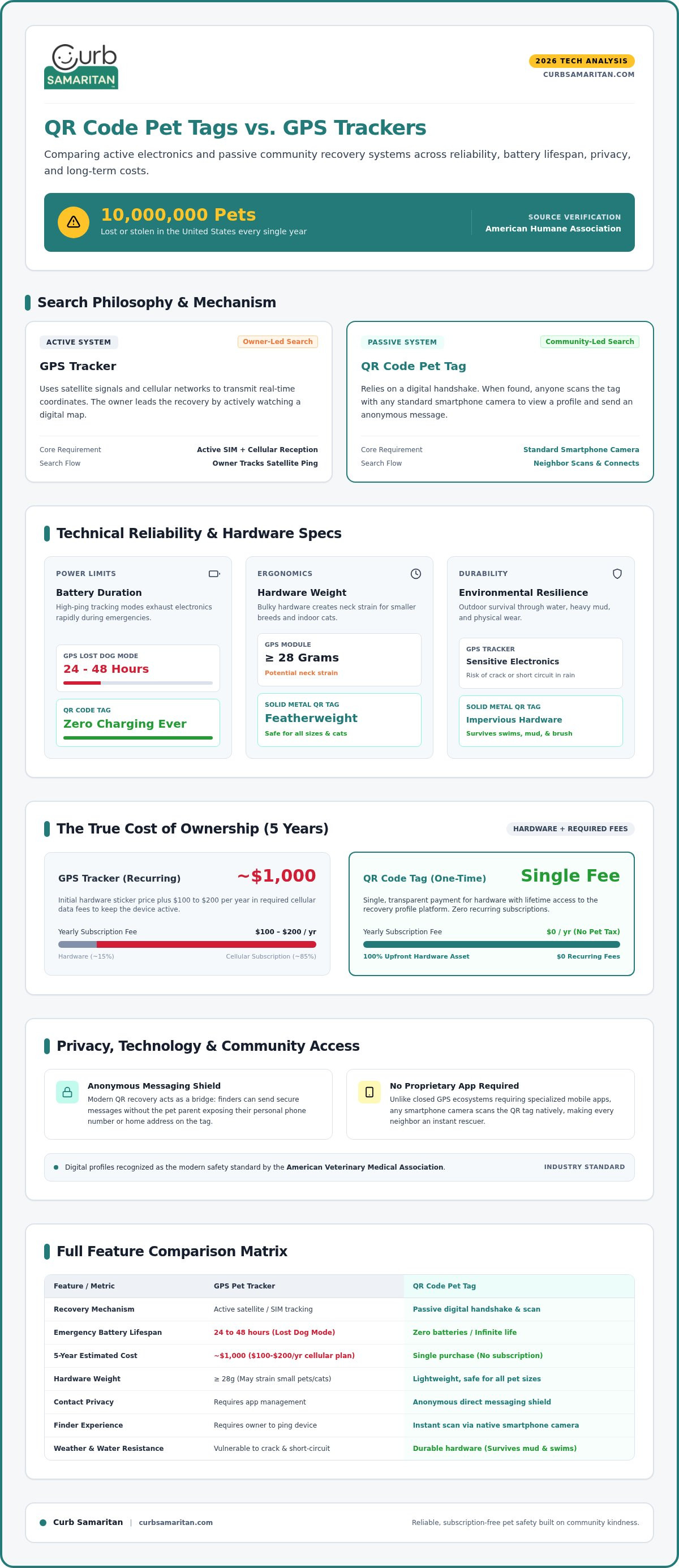
GPS trackers are active devices that use satellite signals to pin down a pet’s exact location in real time. These units usually contain a SIM card and require a cellular connection to send that location data to your phone. While the tech is impressive, it comes with physical trade-offs. Most GPS modules weigh at least 28 grams, which can cause significant neck strain for smaller dogs or indoor cats. They also rely entirely on battery power. If a tracker dies while a pet is missing, the active benefit disappears instantly. This makes them a specialized tool for high-risk wanderers rather than a set-it-and-forget-it solution.
What is a QR Code Pet Tag?
A QR code tag is a passive recovery tool that doesn't need batteries or a cellular plan. When someone finds your pet, they scan the tag with their smartphone camera to view a secure profile. This creates a digital handshake between a neighbor and the owner. Unlike the traditional and QR code pet tags of the past, modern versions don't have to show your personal phone number on the metal. They act as a bridge, allowing a finder to send an anonymous message to the owner. It’s a community-led model that assumes people want to help. It turns every smartphone in your neighborhood into a potential recovery tool without the need for a proprietary app.
The debate over qr code pet tag vs gps tracker often comes down to who leads the search. With GPS, the owner leads by watching a map. With a QR tag, the finder leads by reaching out. In 2026, the shift toward QR technology is driven by a desire for privacy and hardware that never fails due to a dead battery. It’s a reliable, low-maintenance way to stay connected to the people around you.
Technical Breakdown: Reliability, Battery, and Costs
Reliability is the backbone of pet recovery. It's the difference between a quick reunion and a long night of searching. When you weigh the benefits of a qr code pet tag vs gps tracker, you're choosing between two very different power philosophies. One is a high-maintenance active system. The other is a zero-maintenance passive system. Both have their place, but understanding the technical limits of each helps you prepare for the unexpected.
Maintenance and Power: The Passive Advantage
GPS battery life is a constant concern for pet parents. While some 2026 models claim a week of use, they often fail when you need them most. Activating "Lost Dog Mode" forces the device to ping satellites every few seconds. This can drain the battery in as little as 24 to 48 hours. If your pet is hiding or scared, the tracker might die before you reach them. QR tags never face this "dead battery" dilemma. They stay ready for years without a single charge. This "set-it-and-forget-it" approach ensures that even if your pet is found days after going missing, the tag is still perfectly functional.
Durability also plays a role in long-term reliability. Electronics are sensitive to water, mud, and rough play. A GPS collar can crack or short-circuit during a heavy rainstorm. In contrast, a solid metal QR tag is essentially a piece of durable hardware with a digital soul. It can survive a swim in the lake or a tumble through the brush without a glitch. This transition toward digital resilience is noted in the American Veterinary Medical Association overview of digital pet IDs, which highlights how digital profiles are becoming the modern standard for pet safety.
The True Cost of Ownership Over 5 Years
The financial side of pet recovery is about more than the sticker price. GPS hardware is just the starting point. You'll usually pay between $100 and $200 every year for cellular access. Over a five-year period, you could spend nearly $1,000 to keep a single collar active. Even units marketed as "no subscription" often have hidden data limits or fees for real-time updates. Passive tags offer a different path. You pay once for the hardware and get lifetime access to the recovery platform. It's a more sustainable way to protect your pet and your wallet.
Choosing a tool that doesn't require a charging cable is a simple way to reduce daily stress. If you're looking for a safety net that never runs out of juice, consider a People & Pet tag for your companion. It's a reliable, one-time investment in your pet's safety and your own peace of mind.
Busting the Top 3 Myths of Smart Pet Recovery
Choosing the right tech for your pet shouldn't feel like a gamble. Many pet parents assume that more expensive gadgets provide a better safety net, but misconceptions often cloud the reality of how these tools work. When comparing a qr code pet tag vs gps tracker, it’s vital to separate marketing promises from real-world performance. Choosing "no subscription" doesn't mean you're settling for low-tech recovery. It often means you're choosing a more resilient system that doesn't rely on a cellular signal to be useful.
Myth: GPS Provides Guaranteed Location
A common belief is that GPS trackers work everywhere because they use satellites. The truth is more complex. While a device might know where it is via satellite, it needs a cellular signal to tell you where the pet is. This creates "dead zones" in heavy forests, rural pockets, or even your own basement. In cities, tall buildings create "urban canyons" that bounce signals around. This makes your pet’s location look like it's blocks away from where they actually are. In these moments, a neighbor scanning a tag is often much faster and more accurate than waiting for a satellite lock that might never come.
Myth: QR Tags Require the Finder to Have a Special App
Some people worry that a Good Samaritan won't be able to help because they don't have the right software. In 2026, this simply isn't true. Every modern smartphone has a QR reader built directly into the camera. There's no app to download and no account to create. The finder just points their phone, taps a link, and starts the recovery process. This frictionless experience is a core part of why the American Veterinary Medical Association report on digital pet ID technologies sees these tools as a major leap forward for neighborhood safety. It removes the barriers that often stop people from helping a lost animal.
Myth: Traditional Tags are Just as Good as QR
It's easy to think a piece of engraved metal is enough. However, static tags are a permanent privacy risk. They put your home address and personal phone number on display for anyone to see. If you move or change your number, that tag becomes a useless piece of scrap. A digital profile is dynamic. You can update your contact info in seconds without buying a new tag. More importantly, it keeps your data safe. By using privacy focused pet id tags, you can communicate with a finder through secure, anonymous messaging. This protects your personal life while ensuring your pet gets the help they need from the community.
Choosing the Right Tag for Your Pet's Lifestyle
Every pet has a unique way of exploring the world. Some are "bolters" who dart out the front door and hide under a neighbor's porch. Others are "wanderers" who take themselves on long solo walks. When you're deciding on a qr code pet tag vs gps tracker, your pet's personality matters as much as the tech. A 10-pound indoor cat has very different needs than a 70-pound dog that joins you on mountain trails. Choosing the right tool means matching the recovery method to how your pet actually behaves.
Geography is another big factor. In rural farmland, a pet might go miles without seeing a person. In an urban apartment complex, your dog will likely bump into a neighbor within minutes. Passive tags thrive in high-density areas where community help is just a few feet away. They turn your neighborhood into a safety net that's always active, even if you're not looking at a tracking map.
The Urban Pet: Why QR Tags Win in Cities
In a busy city, population density is your best friend. A lost pet in a park or on a sidewalk is usually spotted quickly by a Good Samaritan. QR tags enable a fast scan-to-reunion time because any passerby can help instantly. You also avoid the common GPS interference caused by tall concrete buildings. These structures often block satellite signals, making active trackers jumpy or inaccurate in downtown areas. Anonymous messaging allows you to coordinate a pickup with a stranger without giving away your exact apartment number or personal cell phone to everyone on the street.
The Privacy-Conscious Owner
Protecting your pet shouldn't mean exposing your private life. Traditional engraved tags are a 20th-century risk. They broadcast your name and phone number to anyone who looks at your pet's collar. Modern owners are looking for a higher "Privacy Score" that keeps personal data secure. Using a pet id with secure messaging acts as a digital firewall. It lets you help your pet while keeping your identity private. This is a layered defense that works alongside a microchip, which serves as permanent proof of ownership but requires a vet's help to read.
Ready to upgrade your pet's safety net? You can find durable, subscription-free People & Pet tags that protect your privacy and your peace of mind.
Curb Samaritan: Secure, Subscription-Free Peace of Mind
When you look at the choice between a qr code pet tag vs gps tracker, the most important factor is the human connection. Curb Samaritan People & Pet tags are designed to bridge the gap between a lost pet and a helpful neighbor. We don't see ourselves as just a hardware vendor. We're community advocates who believe that technology should make it easier for people to be kind to one another. Our system removes the barriers that often prevent reunions, creating a seamless path home for your companion. In the debate of qr code pet tag vs gps tracker, we focus on the one thing that never fails: human goodwill.
One of the biggest hurdles in pet recovery is friction. If a finder has to download a bulky mobile app or sign up for a service just to help a dog they found on the sidewalk, they might hesitate. Curb Samaritan removes this roadblock entirely. There's no app required for you or the person who finds your pet. A simple scan opens a secure web portal instantly. This speed is critical when every minute counts. It ensures that help is only a camera tap away, turning any smartphone in the area into a powerful recovery tool.
Lifetime Access Without the Monthly Bill
Pet safety shouldn't be a luxury tied to a monthly bill. We offer a $15 one-time cost model that includes lifetime access to our platform. This approach is built on a resident mindset; once you're part of the system, you're protected forever. You won't have to worry about your service being cut off because a credit card expired or a subscription lapsed. For a deeper look at why this model is the future of pet safety, check out our guide on smart pet id tag lifetime access. It's a sustainable way to keep your family whole without adding another recurring expense to your life.
How Our Secure Messaging Works
Our "Secure Kindness" philosophy ensures that every interaction is protected. When a finder scans the tag, they're prompted to send a message through our anonymous platform. You receive the alert instantly and can coordinate the reunion without ever sharing your personal phone number. This prevents data leaks and keeps your private life off the streets. It's a simple, secure process that empowers your neighbors to do the right thing while keeping everyone's identity safe. We believe in the power of people helping people, and our tech is just the bridge that makes it happen. Secure your pet's future with a Curb Samaritan tag today.
Building a Smarter Safety Net for Your Companion
Securing your pet's future doesn't have to mean managing another monthly bill or worrying about a dead battery. The choice between a qr code pet tag vs gps tracker often comes down to reliability and privacy. While active trackers offer real-time maps, they often fail in cellular dead zones or when the power runs out. A passive QR tag remains ready for a scan at any moment, turning every neighbor with a smartphone into a potential helper. It's a simple, durable solution that protects your personal data through secure messaging while ensuring your pet is never truly alone.
You can choose a recovery system that values community and security over recurring fees. Our durable tags provide lifetime platform access with no monthly charges, keeping your contact information private from strangers while facilitating a safe reunion. Protect your pet with a subscription-free, privacy-first QR tag for only $15. We're here to help you and your neighbors look out for each other, one scan at a time. Your pet's safety is a journey we take together.
Frequently Asked Questions
Do QR code pet tags have a monthly subscription fee?
No, Curb Samaritan QR code pet tags do not require a monthly subscription fee. Unlike many GPS trackers that charge for cellular data plans, our tags include lifetime access to our messaging platform with a single payment. This makes it a sustainable, "set-it-and-forget-it" safety layer for your pet. You won't ever have to worry about a lapsed credit card or an expired service plan when your pet needs help the most.
Can a QR tag track my pet's location in real-time like a GPS?
A QR tag does not provide real-time satellite tracking like a GPS device. In the debate of qr code pet tag vs gps tracker, the tag is a passive recovery tool. It works when someone finds your pet and scans the code with their phone. This initiates an anonymous message to you. While it doesn't show a moving dot on a map, it never runs out of battery and works perfectly in areas where GPS signals fail.
What happens if someone scans my pet's QR tag but doesn't have the app?
Nothing special is required because our system is entirely app-free. When a neighbor scans the tag with their smartphone camera, it opens a secure web-based chat window automatically. This removes the friction that often prevents people from helping a lost pet. By making the process as simple as pointing a camera and tapping a link, we ensure that every Good Samaritan can connect with you instantly without downloading anything or creating an account.
Is my personal phone number visible to anyone who scans the tag?
Your personal phone number stays completely private. When a finder scans the tag, they see a secure portal that allows them to send you an anonymous message. Our platform acts as a protective bridge, routing the communication to you without exposing your actual cell number or home address. This "secure kindness" philosophy prevents data leaks and protects you from potential harassment while still allowing a neighbor to help your pet get home safely.
Do GPS trackers work if my pet is inside a building or basement?
GPS trackers often struggle or fail entirely when a pet is indoors, in a basement, or under heavy tree cover. These devices require a clear line of sight to satellites and a strong cellular signal to transmit data. If your pet hides in a garage or concrete structure, the tracker may show an inaccurate location. This is where a scannable tag provides a reliable backup that doesn't depend on satellite locks or cellular pings.
Why is a QR code tag better than a traditional engraved metal tag?
Traditional engraved tags are static and pose a privacy risk by broadcasting your phone number to everyone. If you move or change your number, an engraved tag becomes useless scrap metal. A QR code tag links to a dynamic digital profile that you can update in seconds. It also protects your identity through anonymous messaging, providing a modern, secure alternative that evolves with your life without requiring you to purchase new physical hardware.
How long does a Curb Samaritan pet tag last?
Curb Samaritan People & Pet tags are designed to last for the lifetime of your companion. Because they are made of high-quality coated metal and contain no electronic parts or batteries, they won't short-circuit in the rain or break if dropped. There are no charging cycles to manage and no software that will become obsolete. Once you attach the tag to a collar, it remains a permanent, zero-maintenance safety tool for your pet's entire life.
Can I update my contact information on the QR tag if I move?
Yes, you can update your contact details at any time through our secure platform. There is no need to buy a new tag if you change your phone number or move to a new home. You simply log in to your account and edit your profile, and the changes are reflected instantly when the tag is scanned. This flexibility ensures your pet's safety net is always accurate, providing you with continuous peace of mind as your life changes.