

Tools for Introverts to Communicate With Neighbors: 7 Low-Pressure Ways
What if getting to know your neighbors didn’t require a doorstep conversation or a long chat in the hallway? If small talk feels awkward or socializing leaves you drained, you’re not alone. The right tools for introverts to communicate with neighbors can make connection more comfortable by giving you time and space to choose when and how you respond.
You don’t have to share your phone number, reply instantly, or turn every hello into a conversation. A short note, a shared community space, or a private way to send an alert can help you be approachable while keeping your boundaries intact.
This guide covers seven low-pressure ways to start and continue neighborly communication, from brief in-person exchanges to slower digital options. You’ll also find practical ways to choose a method that fits your energy and comfort level, so building a little connection feels manageable rather than like another social obligation.
Key Takeaways
- Explore tools for introverts to communicate with neighbors, from prepared greetings and short notes to digital channels.
- Choose an approach for the situation by weighing effort, immediacy, privacy, and your comfort level.
- Try one small communication experiment, then consider whether it felt manageable and useful.
- A Resident Sticker offers a private QR-based option: a passerby can scan it to send a secure, anonymous text alert.
- Neighborly connection doesn’t have to mean constant conversation or sharing your personal contact details.
Why neighbor communication tools can make connecting feel less draining
Wanting a friendly neighborhood and wanting quiet time can both be true. You might appreciate a familiar face, a helpful exchange, or knowing who lives nearby without wanting an unplanned conversation every time you step outside. That isn’t a contradiction. Introversion describes preferences around social energy, not a lack of care for other people. Introversion and extraversion are often discussed separately from shyness, so it can help to choose contact based on what feels comfortable to you rather than on assumptions about how you should socialize.
Communication tools aren’t limited to apps. A prepared greeting, a short note, a familiar routine, or a digital channel can all make it easier to connect. The right tools for introverts to communicate with neighbors can add structure to an interaction: you know what you want to say, why you’re reaching out, and how much time or information you want to share.
Small, predictable exchanges can feel easier to manage than open-ended socializing. A quick hello while taking out the bins has a natural beginning and end. A note about a misdelivered parcel has a clear purpose. Choosing the time and channel also reduces uncertainty: you can leave a message when you’re ready instead of responding on the spot. These small moments can build familiarity without requiring you to become the most outgoing person nearby.
Low-pressure neighbor communication has a clear purpose, a comfortable pace, and room to end or pause the exchange on your terms. It can be warm and genuine without being lengthy or spontaneous.
What makes a neighbor interaction feel low-pressure?
Look for three things: predictability, purpose, and an easy exit. You might say hello on your usual walk, ask one practical question, then continue on your way. Or you could send a brief message that doesn’t require an immediate reply. Choosing the channel and timing lets you prepare, while a closing phrase such as “Enjoy your evening” signals that the conversation is ending naturally.
Preferring quieter contact doesn’t mean disliking people. It can simply mean that conversation feels best when it has some shape and doesn’t take more energy than you want to give.
Connection does not have to mean hosting
Familiarity can grow through ordinary contact, too. A wave, a short welcome note, or a practical message about a shared issue can help neighbors recognize one another and make future exchanges feel less unfamiliar. Hosting is one possible route, not a requirement. If a gathering appeals to you, keep it small and time-bounded, such as inviting a neighbor for a brief coffee on the porch. If not, choose a lighter routine you can sustain, like greeting someone when your paths naturally cross.
The aim isn’t to maximize contact. It’s to find a way of being approachable that leaves room for rest, privacy, and the kind of connection you actually enjoy.
7 Practical tools for talking with neighbors at your pace
There’s no single best way to reach out. A quick greeting may feel easy for one person, while another would rather send a thoughtful message. These tools for introverts to communicate with neighbors include in-person and digital options. For each one, consider the situation, the effort involved, and a manageable first step.
Simple in-person and written ways to start
Start with a natural shared moment or a practical reason to connect. Keep the exchange brief, and choose whether to make it a one-time hello or a familiar routine. None of these options requires hosting or an ongoing conversation.
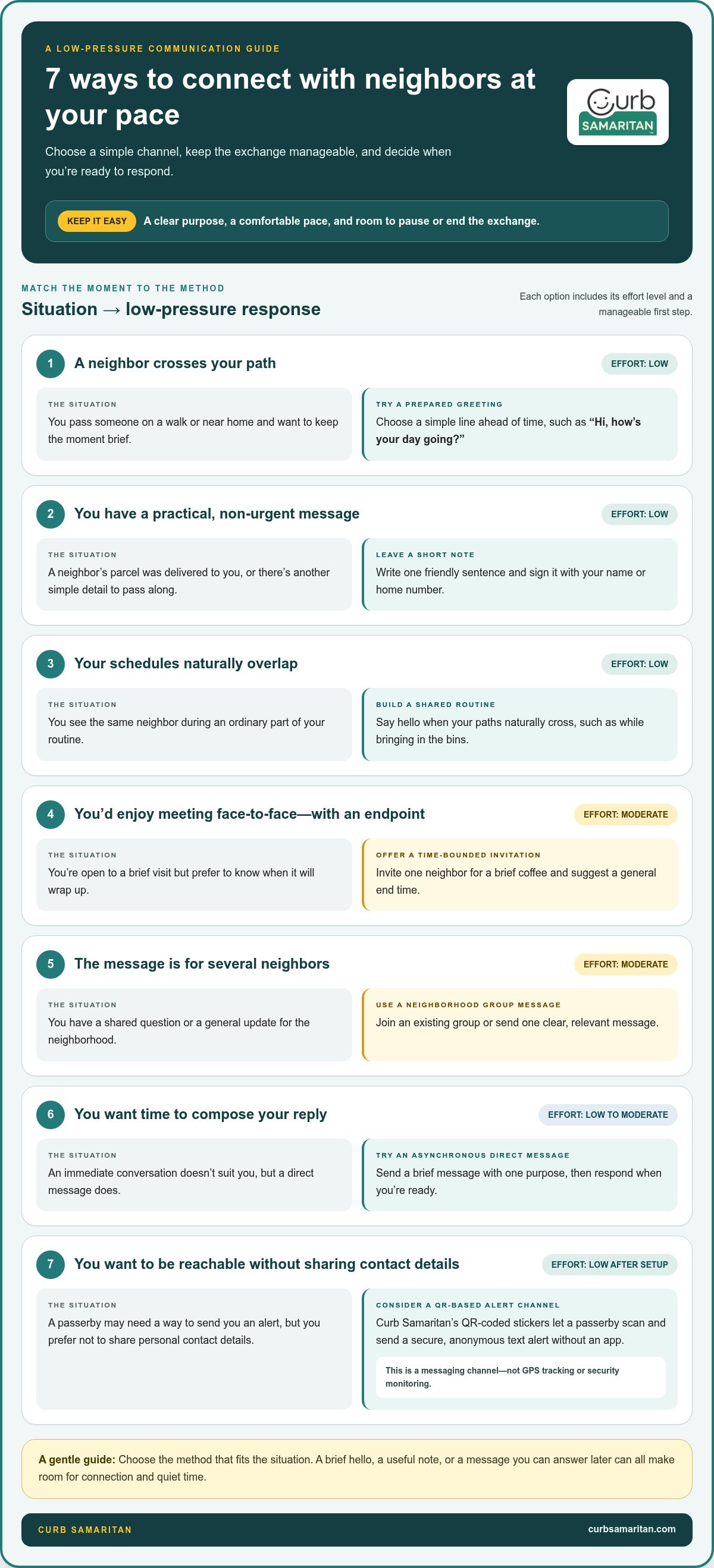
- Prepare a greeting. Suitable when you pass a neighbor on a walk or near your home. Effort: low. First step: choose a simple line, such as “Hi, how’s your day going?”
- Leave a short note. Useful for a non-urgent practical message, such as letting someone know their parcel was delivered to you. Effort: low. First step: write one friendly sentence and sign it with your name or home number.
- Build a shared routine. A repeated moment, like saying hello while bringing in the bins, can make contact more familiar. Effort: low. First step: greet a neighbor when your schedules naturally overlap.
- Offer a small, time-bounded invitation. This may suit you if you’d enjoy meeting face-to-face but want a clear endpoint. Effort: moderate. First step: invite one neighbor for a brief coffee and suggest a general end time.
Digital and privacy-conscious ways to stay reachable
Digital contact can make it easier to choose your words and timing. A group message suits a shared update, while a direct message is more personal. For broader community projects, HUD’s Community Development Block Grant Program is a public resource focused on community development. Everyday neighborly contact, though, can start with a simple message.
- Use a neighborhood group message. Helpful for a shared question or general update. Effort: moderate. First step: join an existing group or send one clear, relevant message.
- Try an asynchronous direct message. A good fit when you’d rather compose a reply at your own pace. Effort: low to moderate. First step: send a brief message with one purpose, then respond when you’re ready.
- Consider a QR-based alert channel. Useful if you want a way for a passerby to reach you without sharing personal contact details. Effort: low after setup. Curb Samaritan’s QR-coded stickers let a passerby scan and send a secure, anonymous text alert without an app. This is a messaging channel, not GPS tracking or security monitoring. Explore resident QR stickers as one option for private contact.
Choose a method that suits the situation, rather than one that asks you to be more social than you want to be. A simple note may be enough for a practical matter; a group message may work better when everyone needs the same update.
How to choose a neighbor communication tool that fits your comfort level
The best channel depends on what you need to communicate, how quickly you need to reach someone, and how much personal information you want to share. The right neighbor communication channel matches the message’s urgency, your privacy needs, and your comfort level. Use this comparison as a starting point, not a rulebook. A face-to-face hello might suit a passing moment, while a written or QR-based option may feel better when you’d rather avoid an unplanned conversation.
| Channel | Effort | Immediacy | Privacy | Good fit |
|---|---|---|---|---|
| Face-to-face greeting | Low | Immediate | Personal, but no details need to be exchanged | A casual hello when you cross paths |
| Short note | Low | Not immediate | Share only the details needed for the message | A simple, non-urgent question or update |
| Group message | Moderate | Usually quick, but replies may vary | Visible to the group, depending on the channel | Practical information several neighbors need |
| QR-based alert | Low after setup | Depends on when it’s scanned and received | Can let a passerby send an alert without sharing personal contact details | A passerby needs a way to contact a resident |
Which channel suits a quick, planned, or private message?
Match the channel to the task. A brief greeting works for a casual moment; a note suits a straightforward, non-urgent message. Use a group channel when several neighbors need the same practical update. A QR-based alert gives a passerby a way to contact a resident without asking for their number. Anonymous messaging can help protect contact details, but it isn’t a replacement for emergency services when urgent help is needed.
Effort and immediacy aren’t the same. A spoken hello takes little preparation but happens in real time. A note or message lets you choose your words and send them when you’re ready, though the other person may not see it right away. A group message can save repeated explanations, but it may share your profile or contact information with other members. Check what the channel displays before posting personal details.
How to set boundaries without seeming unwelcoming
Clear expectations can make a channel easier for everyone to use. Where appropriate, say that you usually check messages in the evening or may take a little while to reply. Share only what the conversation needs; a practical update rarely requires your full schedule or personal number. A slower reply doesn’t have to mean rejection. You may simply be busy, offline, or taking time to respond thoughtfully.
Use privacy and comfort as practical filters when choosing tools for introverts to communicate with neighbors: ask whether the message is urgent, who needs to receive it, and what details they actually need. If a channel answers those questions without adding pressure, it may be a good fit for that exchange. You can choose differently next time.
A gentle plan for trying one neighbor communication tool
You don’t need to make a new friend in one conversation. Treat a first attempt as a small experiment: choose one method, give it one clear purpose, try it once, then decide whether it suited you. This keeps the goal manageable and helps you learn what feels comfortable in practice.
Start with a purpose small enough to act on
Pick an ordinary reason to reach out, such as returning a misdelivered item or welcoming someone who has just moved in. A note or asynchronous message can work if catching a neighbor at the right moment feels difficult. Keep the message brief, warm, and easy to personalize. There’s no need to plan a bigger relationship around a simple first exchange.
- Pick one tool. Choose a greeting, note, direct message, or another channel that fits your energy today. Avoid combining several methods at once; a single choice makes it easier to see what worked.
- Choose one small purpose. Decide what you want the interaction to do. For example, you might return an item, share a brief welcome, or pass along a practical update. A specific purpose gives you a natural opening and a clear stopping point.
- Try it at a manageable pace. Choose a moment that feels convenient, rather than creating pressure to act immediately. You could say, “Hi, I’m glad you’re here. I’m your neighbor in the blue house,” or write, “This parcel was left at my door. I think it’s yours.” Adjust the wording to sound like you.
- Reflect, then choose what’s next. Ask yourself whether the method felt comfortable, the purpose was clear, and you shared only what you wanted to share. You don’t need to judge the exchange by how long it lasted or whether it led to more conversation.
Review what worked and change one thing
If the first attempt felt draining, adjust one part rather than deciding that neighbor contact isn’t for you. Shorten the message, choose a quieter time, or switch from a doorstep greeting to a note. If it felt easy enough, repeat the same approach another time. One useful, respectful exchange can be a complete first step.
Keep ordinary care in mind without letting it turn into worry. Share only details that fit the purpose, and use a channel you’re comfortable with. A friendly exchange doesn’t require immediate trust or an ongoing commitment. The most useful tools for introverts to communicate with neighbors are the ones you can use at a sustainable pace.
If a private way for a passerby to reach you would suit your needs, explore Curb Samaritan’s resident QR stickers as one option for neighbor communication.
A private QR alert option for residents who prefer less direct contact
Some neighbor interactions begin because someone nearby needs to pass along useful information, not because either person is looking for a conversation. A QR-based resident alert offers a way to make that contact without posting a personal phone number or arranging a face-to-face exchange. It’s one option in a wider toolkit, suited to a specific kind of message rather than every kind of neighborly connection.
How a QR-based resident alert fits into the toolkit
Curb Samaritan’s Resident Sticker gives a passerby a simple route to contact a resident: scan the QR code and send a secure, anonymous text alert. Scanning doesn’t require a mobile app, and the passerby doesn’t need the resident’s personal contact information. The sticker supports contact initiated by someone nearby. It isn’t designed for ongoing neighborhood conversation, GPS tracking, or professional security monitoring.
That distinction helps set expectations. A group message can keep neighbors updated, and a direct conversation can build familiarity. A QR alert instead provides a way to send a message when a passerby has a reason to reach the resident. It doesn’t ensure a reply or a particular outcome, and it isn’t a substitute for emergency services when urgent help is needed.
When to consider a resident sticker
A Resident Sticker may suit someone who wants a contact channel available without displaying personal contact details. It can complement other tools for introverts to communicate with neighbors, especially if you’re comfortable being reachable for a practical alert but prefer not to exchange numbers with every person nearby.
Think about the purpose before choosing this method. A sticker doesn’t introduce you to neighbors or replace a hello, note, or direct conversation. It offers another way for a passerby to send a message. Each purchase includes lifetime access to the messaging platform without recurring subscription fees. That describes access to the platform, not a promise that an alert will receive a response.
Explore the Resident Sticker as a private-minded option for this kind of contact. It offers a practical way for someone nearby to send an alert without needing your phone number.
Make neighborly connection work for you
Let connection grow in small, ordinary ways. You might begin with one comfortable exchange, then decide later whether you’d like more contact or prefer to keep things simple. Your needs can change with your schedule, energy, and the kind of relationship you want to build. There’s no need to follow a fixed pace or turn every friendly moment into a commitment.
The best tools for introverts to communicate with neighbors are the ones that leave you feeling like yourself. A thoughtful boundary can make connection more sustainable, and a small gesture can give someone nearby an opening to offer or receive kindness. Start where you are and adjust as you learn what feels right.
To make it easier for a passerby to send you a private, practical message, explore Curb Samaritan’s Resident Sticker. Build a sense of community at your own pace, one comfortable interaction at a time.
Frequently Asked Questions
Is it normal for introverts to find neighbor conversations tiring?
Yes, some conversations take more energy than others. People vary, and even the same person may enjoy chatting one day and prefer quiet the next. Introversion doesn’t mean someone dislikes people. If you’re looking for tools for introverts to communicate with neighbors, try a brief exchange or a written message you can send when ready. You’re free to choose the pace and level of contact that feel right.
Can I get to know my neighbors without inviting them into my home?
Yes. Familiarity can grow without anyone coming inside. A wave on the way to collect mail, a practical note, or a short chat outdoors can help you recognize one another over time. Keep your first step modest, such as introducing yourself and sharing which home is yours. You don’t have to turn a friendly exchange into a gathering or close friendship. A comfortable neighborly connection can stay simple.
How do I start a conversation with a neighbor if I feel awkward?
Choose a natural moment and say something connected to what’s happening. If you meet while collecting mail, try, “Hi, I don’t think we’ve met yet. I’m Alex from down the path.” Keep it brief, then let the other person decide whether to continue. A polite hello is enough for a first step. You don’t need a clever opener or a perfectly smooth conversation; it’s an ordinary interaction, not a performance.
What can I write in a note to a new neighbor?
Keep it warm and short: “Hi, welcome! I’m Sam from the house across the way. I hope you’re settling in well.” You can add a practical offer, such as pointing out where shared recycling bins are, if it’s useful. Include only the personal details you’re comfortable sharing, and don’t ask for a reply. A note lets the new neighbor read it at their convenience and decide whether or when to respond.
Can a QR code help neighbors contact me without my phone number?
Yes. Curb Samaritan QR-coded stickers let a passerby scan and send a secure, anonymous text alert without using a mobile app or needing your personal contact information. This offers a way to send a message, not location tracking or monitored security. Consider whether you want to be reachable for that kind of contact, and remember that an alert may not receive a response. It isn’t a substitute for emergency services.
What if I do not want to respond to a neighbor right away?
You can usually reply when you have the time and energy, unless the message needs urgent attention. If you’re part of a shared group, you might mention that you check messages periodically rather than continuously. For a message that needs acknowledgment, a brief “I’ve seen this and will reply later” can set expectations without starting a longer conversation. Taking time to respond is a reasonable boundary and doesn’t automatically signal disinterest.
How can I be friendly with neighbors while keeping personal information private?
Share only what the conversation needs. You can introduce yourself without giving out your schedule, personal number, or other details, and choose a note or group channel based on who needs the information. Avoid displaying contact details publicly if the purpose can be met another way. A warm greeting and clear boundaries can go together. For situations where a passerby needs to send a message, an anonymous alert option may suit your preferences.