

7 Impactful Ways to Use QR Code Posters for Community Safety and Connection
What if a neighborhood alert could reach the right people without putting anyone’s phone number on a public pole? That’s the promise of qr code posters for community use: a simple way to connect neighbors while keeping personal contact details private. Unlike paper flyers with tear-off tabs, a QR code can give people a direct way to send a message.
It’s understandable to hesitate before sharing contact information in a public place. Neighbors need a quick way to flag a concern, but staying connected shouldn’t mean inviting unwanted calls or messages. Privacy-first QR code posters can help people communicate without revealing their phone numbers, and scanning doesn’t require a mobile app.
This article covers seven practical ways to use QR code posters to support community safety and connection, from sharing neighborhood updates to helping reunite people with lost pets or belongings. You’ll also learn how clear poster messages and easy scanning can encourage neighbors to take part.
Key Takeaways
- See how qr code posters for community spaces can turn everyday noticeboards into useful entry points for communication.
- Explore practical ways to organize lost-and-found messages and share neighborhood safety updates.
- Learn how privacy-shielded messaging can help neighbors connect without displaying personal phone numbers.
- Use simple design and placement choices to make posters easier to scan and more durable outdoors.
- Find out how Curb Samaritan QR Code Posters and the Neighborhood Connect Sticker Bundle can support community organizers, with lifetime access and no recurring subscription fees.
What are QR Code Posters for Community Engagement?
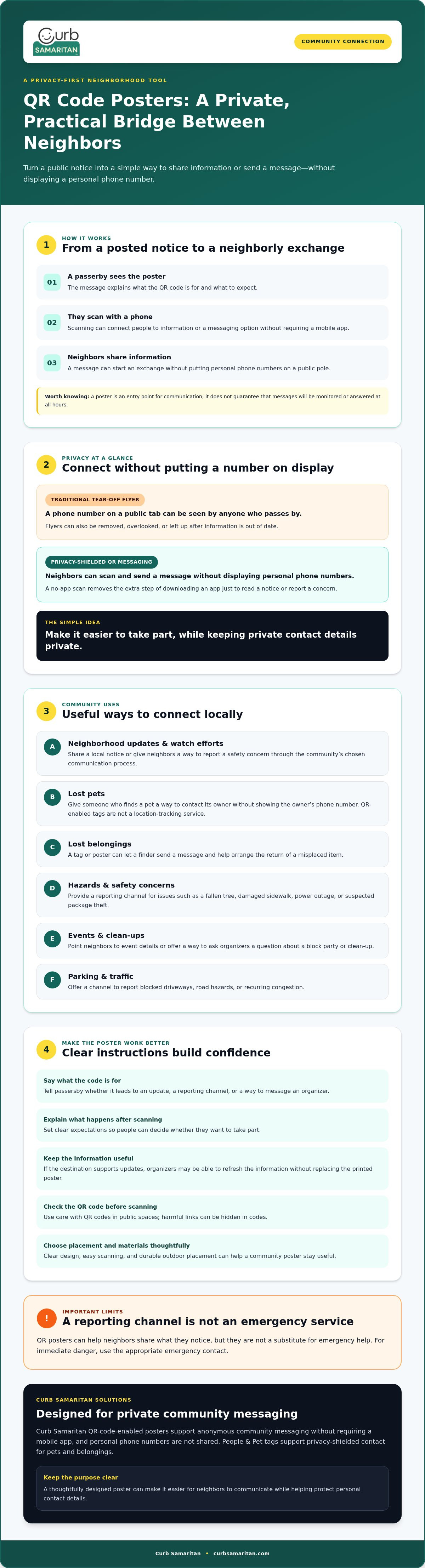
QR code posters give neighbors a simple digital entry point for local communication. A passerby scans the code with a phone and can reach information or a messaging option without searching for a website or writing down a number. The QR code is a scannable pattern that connects a physical poster to digital content. Used thoughtfully, qr code posters for community spaces can make it easier to share a concern, ask for help, or pass along a useful update.
That makes them a natural fit for Neighborhood Watch efforts. A poster can invite people to report a safety hazard or share a concern through a privacy-shielded messaging channel, rather than publishing a resident’s personal contact details. This is “Secure Kindness” in practice: neighbors can offer help and communicate while keeping their phone numbers private.
The Evolution of the Community Bulletin Board
Paper flyers still spread information, but tear-off phone tabs can expose a resident’s number to anyone who passes by. They can also be removed, overlooked, or left up after the information is out of date. A QR poster can point people toward digital information instead. If its destination supports updates, organizers may be able to refresh that information without replacing the printed poster. The poster remains a visible entry point, but it doesn’t guarantee that a message will be monitored or answered at all hours.
Why No-App Scanning Is Critical for Participation
Asking someone to download an app just to report a loose dog or read a neighborhood notice adds extra steps. Some people may not want another app, may not have space on their phone, or may simply keep walking. A no-app scan lowers that barrier. Curb Samaritan’s QR-code-enabled posters support anonymous community messaging without requiring a mobile app, and personal phone numbers aren’t shared. A passerby can scan and send a message without either person putting private contact details on display.
This simplicity matters in shared spaces. A clear poster can explain what the code is for and what to expect after scanning, helping people decide whether they want to take part. Used for alerts or everyday neighborly help, qr code posters for community communication turn a static notice into a practical bridge between people without asking them to give up their privacy just to connect.
Top Community Use Cases for QR Code Posters
QR code posters for community spaces can do more than point to an announcement. They can give neighbors a way to share information: a passerby scans, sends a message, and starts an exchange without needing a public phone number. Here are practical ways to use that connection.
Lost Pet Recovery Without the Privacy Risk
A pet’s QR-enabled tag or poster can give a finder a way to contact the owner without displaying the owner’s phone number. That’s useful if a dog slips out or someone finds a cat. Traditional ID tags can expose contact details to anyone who reads them; privacy-shielded messaging offers another route. Curb Samaritan’s People & Pet tags support this kind of contact, but they shouldn’t be mistaken for a location-tracking service.
The same approach can help with lost belongings. A poster or tag can give someone who finds a misplaced item a simple way to send a message, making it easier to arrange its return.
Neighborhood Safety and Hazard Reporting
A fallen tree, a damaged sidewalk, a power outage, or a suspected package theft can affect more than one household. A QR poster can give a neighbor a direct way to report what they noticed and alert others through the community’s chosen communication process. Treat it as a convenient reporting channel, not an emergency service. For immediate danger, use the appropriate emergency contact.
Anonymous messaging can make it more comfortable to speak up without sharing personal contact details. Learn more about anonymous messaging for neighbors and how privacy can support trust. It’s also sensible to check that a QR code poster is legitimate before scanning. The Federal Trade Commission shares secure QR code practices for avoiding harmful links hidden in QR codes.
Events, Clean-Ups, Parking, and Traffic
For a block party or a clean-up, a poster can link neighbors to event details or offer a way to ask organizers a question. For parking and traffic concerns, it can provide a channel to report blocked driveways, road hazards, or recurring congestion. Clear instructions help people understand what to share and where their message will go.
For public-facing community alerts, Curb Samaritan QR Code Posters offer an option to consider. Explore QR Code Posters for neighborhood communication as a way to help neighbors share useful updates while keeping personal phone numbers private.
Privacy First: Why Secure QR Codes Beat Traditional Contact Methods
A phone number on a public flyer can travel much farther than the message intended. Anyone passing by can copy it, photograph it, or share it. That exposure doesn’t mean identity theft will follow, but it can make unwanted calls and texts easier and give scammers a detail they may use in targeted phishing attempts. For neighbors who want to help, contacting a stranger directly can feel uncomfortable too.
The Hidden Risks of Public Phone Numbers
Traditional tear-off tabs ask people to share personal contact details just to report a found item or ask about a notice. A phone number may also be linked to other information about its owner, so posting it publicly can reduce control over who can reach them and what they learn. Harassment and unsolicited solicitations are possible, even when the original poster has a good purpose.
Curb Samaritan’s QR-code-enabled posters and stickers provide a privacy shield for community messaging: people can connect without displaying personal phone numbers. That can help a resident report a concern or a finder contact an item’s owner while keeping direct contact details private. A QR code alone doesn’t guarantee safety, so check that a poster and its destination are trustworthy before sending sensitive information.
Building Trust Through Secure Messaging
There’s a social barrier to helping, too. Calling a stranger can feel awkward, and answering an unknown caller may feel just as uneasy. A message offers a less pressured first step. Someone who finds keys, spots a loose pet, or notices a problem can share what happened without starting with a personal phone call. That small shift may make it easier for neighbors to act on good intentions.
With Curb Samaritan, messaging is designed to be anonymous, and personal phone numbers aren’t shared. This protects privacy in the exchange, but it shouldn’t be described as a guarantee that every detail or interaction is untraceable. Share only the information needed to resolve the issue, and avoid including sensitive personal details in a message.
Privacy can make community communication feel more approachable. People may be more willing to report a concern or offer help when they don’t have to publish their number or call someone they’ve never met. For more ways to keep contact details private, see this guide to secure messaging stickers for home privacy.
Best Practices for Designing and Placing Community Posters
A useful poster should make three things clear at a glance: what it’s for, what happens after someone scans, and how to take part. Keep the layout simple. Decorative graphics and crowded text can distract from the code, while a short headline and clear instructions help neighbors understand the purpose quickly. Good design isn’t about adding more. It’s about making the next step easy.
Designing for the Quick Scan
Use strong contrast, such as a dark QR code on a light background, and leave open space around the code. That clear border, sometimes called a quiet zone, helps scanning work as intended. There isn’t one reliable code size for every standard 8.5-by-11-inch poster: the best size depends on how far away people will be when they scan. Test the printed poster from its planned viewing distance, and enlarge the code if scanning feels difficult.
Pair the code with a plain-language call to action. For example, “Scan to report a neighborhood concern” tells people what to expect better than a QR code alone. Keep the headline brief, make the code easy to find, and avoid placing text or artwork too close to it. Before putting up copies, scan a test print with a phone to check that the code works and the destination is correct.
Placement Strategy for Neighborhood Success
Think about where a neighbor would naturally pause and notice a poster. Mail areas, community entryways, and park noticeboards may offer visibility, but only use locations where posting is allowed. Ask the property owner or site manager for permission when needed, and check local rules before placing posters in public spaces. A well-designed poster won’t help if it’s removed or blocks another notice.
Outdoor posters face rain, sun, and wear. Choose a suitable protective covering or sheltered location, then check the poster periodically for fading, damage, or a code that’s become hard to scan. If the message changes, make sure the digital destination is still accurate. Don’t assume every QR code can be edited after printing. If the link can’t be updated, replace the poster so it doesn’t direct people to outdated information.
For public-facing alerts, qr code posters for community use work best when a passerby can read the purpose, scan comfortably, and understand what happens next. Curb Samaritan QR Code Posters are designed for community messaging without sharing personal phone numbers. Explore QR Code Posters as an option for sharing neighborhood updates.
Enhancing Neighborhood Safety with Curb Samaritan QR Solutions
A neighborhood communication tool works best when it’s easy for people to join and comfortable to use. Curb Samaritan’s QR-code-enabled products are designed to help neighbors send messages without sharing personal phone numbers or downloading an app. They offer a practical starting point for community organizers who want to make it easier to ask for help or pass along information.
The Neighborhood Connect Bundle: A Community Starter Kit
The Neighborhood Connect Sticker Bundle is a starter option for organizers. It includes Resident, Driver, and Found stickers, giving a community different ways to support neighbor-to-neighbor contact. Organizers can decide which participating households or drivers would benefit from a sticker, then explain what each one is intended for. For public-facing alerts, QR Code Posters offer a separate way to make a community message visible to passersby.
Start with a clear purpose. Let neighbors know what the communication channel is for, how to scan and send a message, and what information to avoid sharing. A consistent explanation helps people understand the tool and decide whether they want to take part. Posters can introduce the channel to a wider group, while stickers give participating residents another way to make private messaging available in everyday situations.
Getting Started with Secure Community Messaging
Keep setup practical rather than complicated. First, choose the purpose for a poster or sticker. Next, place it where the intended audience can see and scan it, with a short instruction explaining what to expect. Before sharing it widely, scan the code yourself and confirm that the messaging destination is working as intended. Neighbors can then scan with a phone and send a message without installing an app.
Different messages call for different instructions. A poster for community updates should say what kinds of messages are welcome; a Found sticker should make clear that it helps someone contact an owner about a found item. Don’t imply that a QR code is an emergency response channel, and remind neighbors to contact the appropriate emergency service if there’s immediate danger.
Curb Samaritan describes its products as offering lifetime access with no recurring subscription fees after a one-time purchase. That can make ongoing access simpler to plan for, while privacy-shielded messaging helps neighbors connect without putting personal numbers on public display.
That’s the idea behind “Secure Kindness”: make it easier to offer help while keeping private contact details private. A neighbor can send a useful message, and an organizer can make a communication option visible without anyone publishing a personal number to get started. With qr code posters for community alerts and stickers for participating neighbors, organizers can build a clearer path for everyday communication.
Make Neighborly Help Easier to Share
Strong communities grow through small acts of care: reporting a hazard, helping return a lost item, or sharing a useful update. Thoughtfully placed qr code posters for community spaces give neighbors a simple way to start those exchanges without posting personal phone numbers in public. Clear instructions, an easy scan, and privacy-aware messaging can make taking part feel more comfortable.
Keep the purpose clear, choose a visible and permitted location, and make sure the message people reach is still useful. These practical steps help turn a poster from a static notice into a welcoming connection point. The goal isn’t more technology for its own sake. It’s making it easier for neighbors to help one another.
Curb Samaritan’s Neighborhood Connect Bundle offers community organizers a way to begin, with no app required, no recurring subscriptions, and lifetime messaging included. Explore the Neighborhood Connect Bundle to take a thoughtful step toward more connected community communication.
Frequently Asked Questions
Do my neighbors need to download an app to use the QR code poster?
No, neighbors don’t need to download an app to scan and message through Curb Samaritan’s QR-code-enabled products. They can use their phone’s camera to scan the code and follow the message prompt. That makes participation easier for people who don’t want another app. Add a short instruction beside the code so passersby know what it’s for before they scan.
Is there a monthly fee for the Curb Samaritan messaging service?
No. Curb Samaritan products include lifetime access to the messaging platform with a one-time purchase, so there are no recurring subscription fees. That can make ongoing use easier for community organizers to plan. Check the product information for the specific item you’re considering, and explain to participating neighbors how the messaging channel is intended to be used.
What happens if someone scans the code and tries to send a prank message?
A QR code can’t prevent someone from sending an inappropriate message, and specific blocking or moderation features shouldn’t be assumed. Keep the poster’s instructions focused on its purpose, such as reporting a found item or sharing a community concern. Don’t include sensitive details in a reply. If a message feels threatening or indicates immediate danger, use the appropriate emergency or safety resources rather than relying on the poster.
Can I use these QR code posters for my local HOA or neighborhood watch?
Yes, an HOA or neighborhood watch can consider qr code posters for community updates or neighbor-to-neighbor messages. Agree on the poster’s purpose first, such as reporting hazards or sharing a lost-and-found notice, and make clear who will receive messages. Get permission before posting on property you don’t manage. The poster provides a way to communicate, but it isn’t a replacement for emergency services or an official alert system.
Will my personal phone number be visible to anyone who scans the poster?
No. Curb Samaritan’s privacy-first messaging is designed so personal phone numbers aren’t shared between the person scanning and the owner. This gives neighbors a way to make contact without printing a number on a public notice. Still, avoid putting private details in the poster text or messages. Share only the information needed to handle the situation, such as where an item was found.
How do I receive alerts when someone scans my community poster?
A scan by itself isn’t necessarily an alert. Curb Samaritan products enable secure, anonymous messaging, so a passerby can send a message through the QR-code experience. The available information doesn’t specify how owners are notified or whether every scan triggers a message. Before putting up a poster, review the product’s setup instructions and confirm how incoming messages are delivered, then test the process.
Are the posters weather-resistant for outdoor community boards?
Weather resistance isn’t confirmed for Curb Samaritan QR Code Posters, so don’t assume they’re made for prolonged outdoor exposure. If you plan to post one outside, check the product details for material and care guidance first. A sheltered, permitted location may help reduce exposure to rain and sun. Inspect the poster regularly, and replace it if the print fades, tears, or becomes difficult to scan.
Can I use one QR code for multiple community purposes?
Don’t assume one code can serve several purposes or that its destination can be changed. The available product information doesn’t confirm whether a code supports multiple message types or editable destinations. For clarity, give each poster a clear, specific purpose, such as lost-and-found messages or neighborhood updates. If you want one code to cover more than one use, check the product instructions before printing or distributing it.