

How to Return Lost Items Safely: A Practical Guide
What if returning a lost item safely starts with keeping a little distance? Knowing how to return lost items safely means helping the owner while protecting your privacy and comfort. You may be deciding whether to contact them, hand the item to staff, or avoid sharing your phone number.
A kind gesture shouldn’t require giving a stranger your address or agreeing to a meeting that doesn’t feel right. You can offer a clear way to reconnect while setting sensible boundaries.
This guide explains how to choose a return channel, protect personal details, and plan a practical handoff. A venue’s lost-and-found desk may be a better option than direct contact in some situations. If an item has a Found Sticker, its QR code lets a finder send a secure, anonymous text alert without an app or sharing personal contact information. Whether you use QR messaging or not, a safe return can be simple and comfortable for everyone.
Key Takeaways
- Learn how to return lost items safely by assessing the setting and choosing a suitable return route.
- Protect your privacy by keeping personal contact details and identifying information out of public posts.
- Compare staffed lost-and-found desks, direct contact, and QR messaging to find a practical way to reconnect.
- Use a five-step approach to move from finding an item to arranging a sensible handoff.
- A Found Sticker lets a finder scan a QR code and send an anonymous text alert without installing an app.
How to Return a Lost Item Safely: Start With These First Steps
Finding something that belongs to someone else is a chance to help. You don’t need to put yourself at risk or pry into someone’s private life to make a thoughtful return. If you’re working out how to return lost items safely, pause first: assess the surroundings, protect personal details, and consider whether the item or situation seems unsafe.
A safe return protects the finder, the owner, and the item without asking anyone to take unnecessary risks or give up their privacy.
What should you do first when you find something?
Check your surroundings before approaching the item. Consider traffic, crowds, and whether anyone nearby is behaving in a way that makes you uneasy. Note where and when you found it so you can describe the circumstances later. Don’t open a phone, wallet, bag, or document to look for the owner. If you found the item at a business or other staffed location, its lost-and-found process may be the simplest first step.
- Check the setting: Stay aware of traffic, crowds, and people nearby.
- Keep details private: Don’t post names, card numbers, addresses, or distinctive identifying details publicly.
- Record the basics: Remember when and where you found the item, and describe it without sharing sensitive contents.
Which lost items need extra care?
Phones, wallets, keys, identification, and bags may contain sensitive information or provide access to someone’s property. Handle them only as needed to keep them safe. Don’t try passwords, open accounts, use payment cards, or search through private contents. If an item seems dangerous or suspicious, don’t touch or move it. Step away and seek appropriate help.
Where you find something can help determine what to do next. An item left on a shop counter may belong with the staff there, while an item found elsewhere may call for a different route. The legal status of found items discusses distinctions such as lost and mislaid property, but rules can vary by location. Don’t assume every found item should be handled the same way.
Once you’ve determined it’s safe to act, choose a return method that respects both the owner’s privacy and your own. The goal isn’t to investigate who owns the item. Preserve it, share only what’s needed, and make a sensible return possible.
How to Protect Your Safety and Privacy While Returning Lost Items
Returning a lost item is kind, but kindness doesn’t require sharing your personal phone number or meeting someone alone. You can help the owner while keeping clear boundaries. Share only the information needed to arrange the return, and no more.
How can you contact an owner without exposing personal details?
If the item was left at a business, school, or venue, start with its staffed lost-and-found channel. The owner can ask about it at a familiar location without needing to contact you directly. If you post a notice, keep the description broad. For example, say you found keys near a café, but leave out a distinctive keychain or tag that could help someone falsely claim them. Ask the owner to describe the item privately.
Don’t post names, serial numbers, addresses, full identification details, access codes, or photos that reveal them. Keep your home address and personal number out of public posts, too. If the item has a contact option designed to protect personal details, such as a QR code for anonymous messaging, it can provide a direct way to connect. A QR-coded Found Sticker lets a finder send an anonymous text alert without installing an app or sharing personal contact information.
How do you arrange a safer handoff?
If meeting in person makes sense, agree on a public, staffed location and a reasonable time. A business lost-and-found desk or staffed reception area can keep the exchange straightforward. Tell someone you trust where you’re going and when. Don’t enter a stranger’s home or invite them to yours. If either person feels uncomfortable, change the plan and use a suitable lost-and-found or authority channel instead.
- Share only what’s needed: Give a general description and a way to coordinate, not private account or identity details.
- Keep the meeting public: Choose a staffed place rather than a private home or isolated spot.
- Trust your boundaries: You can stop direct communication and use an intermediary if the exchange feels uneasy.
Privacy matters throughout the return process. Cornell Law School explains common law principles for lost property. For a safe handoff, the practical point is simple: help the owner reconnect with the item without revealing more than necessary.
Compare Safe Ways to Return a Lost Item
The right return method depends on the item, where you found it, and which contact options feel safe. A staffed desk can simplify the exchange at a venue. Direct contact may work when the owner has provided a suitable way to reach them. QR messaging can offer a private way to contact an owner without exchanging personal details. No method guarantees a response or recovery.
| Return option | Privacy | Convenience | Best suited to | In-person handoff? |
|---|---|---|---|---|
| Staffed lost-and-found desk | Good, if you hand it to staff rather than posting identifying details | Simple when the item was found at that venue | Items left in a shop, school, venue, or other staffed location | Usually, to hand it in; the owner can arrange collection with the venue |
| Direct contact | Depends on how contact details are shared | Can be quick if the owner has provided a safe contact route | Items with a clear, appropriate way to reach the owner | Possibly, depending on the agreed return plan |
| Privacy-preserving QR messaging | Can keep personal contact details private | Convenient when the item has a QR code linked to messaging | Tagged belongings when a private message route is available | Not necessarily; the owner and finder can discuss next steps |
When is a lost-and-found desk the sensible choice?
If you find something inside a business or venue, its staffed desk is often the simplest first choice. Staff can receive the item where it was found, so you may not need to contact the owner or arrange a meeting. Note when and where you handed it over, and don’t share sensitive details from inside the item.
When can anonymous QR messaging help?
If an item has a QR code for private contact, the finder can scan it and message the owner without exchanging personal phone numbers. Curb Samaritan’s Found Sticker provides this kind of contact, letting a finder send an anonymous text alert without a separate app. It’s a communication option, not a safety assessment or a promise that the owner will respond. Read the no-app QR contact sticker guide to learn more about how QR messaging works.
Direct contact may be practical when the owner has left a suitable way to reach them. Keep the conversation focused on confirming the item and choosing a comfortable handoff. A public, staffed location or private message route can help you avoid sharing your address or meeting alone. To decide how to return lost items safely, match the channel to the item and setting while respecting both people’s boundaries.
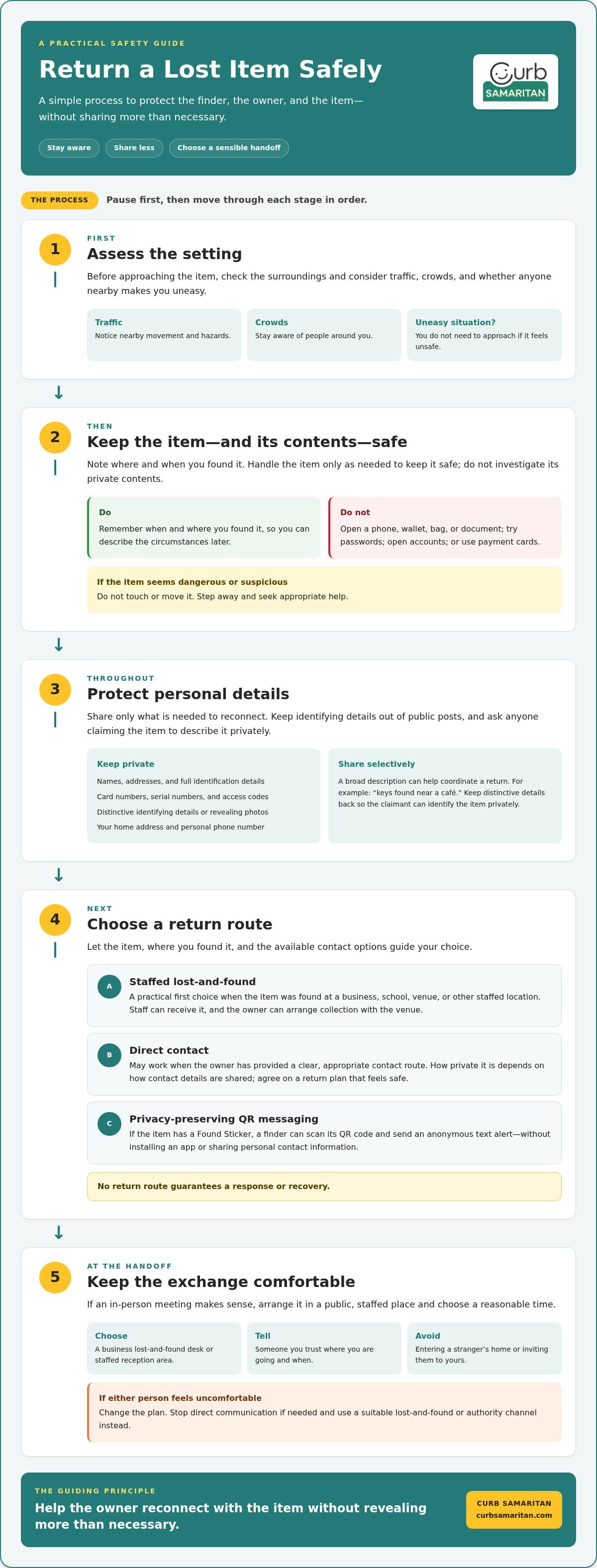
How to Return a Lost Item Safely in Five Steps
A clear sequence can make the return manageable, even if you’re unsure where to begin. Follow these steps to help without overlooking a safety concern or sharing more than necessary.
- Step 1: Assess the situation. Check whether the location and item seem safe to approach. If an object looks suspicious or potentially dangerous, don’t handle it. Move away and seek appropriate help.
- Step 2: Protect private information. Keep wallets, bags, and devices closed. Don’t try passwords, open accounts, or use cards. For example, you can say you found a wallet without sharing its identification or contents.
- Step 3: Choose a return channel. Match the method to the item and setting. A phone left in a café may belong at the staffed lost-and-found desk. A tagged pet’s QR code may provide a direct route to contact the owner. For more on this option, see the lost-and-found QR tag guide.
- Step 4: Contact the owner carefully. Give a general description and ask them to confirm a detail you haven’t shared publicly. Keep your message courteous and avoid unnecessary personal information.
- Step 5: Complete a sensible handoff. Agree on a suitable route, such as the venue’s staffed desk or a public, staffed meeting place. If the arrangement feels uncomfortable, switch to an appropriate intermediary.
What should you say in the first message?
Keep it brief: “I found an item near the library. Can you describe it so I can make sure it’s yours?” Don’t include every identifying feature in your first message. Ask the person to confirm a detail, then discuss a handoff that feels reasonable to both of you.
What if the owner does not respond?
Give the owner a reasonable opportunity to reply, then try another suitable route rather than sending repeated messages. If you found the item inside a business or venue, use its staffed lost-and-found process. Don’t post private details to attract the owner’s attention. Curb Samaritan’s Found Sticker lets a finder send an anonymous text alert without installing an app. Explore QR-coded Found Stickers as one option for private owner contact.
These steps keep the focus on a safe, respectful attempt to reconnect an owner with their belongings. A response isn’t guaranteed, but a clear message and sensible handoff give the return a practical path forward.
Use a Found Sticker for a Private, Simple Return
A Found Sticker offers a way to contact an owner while keeping personal contact details private. It can make the first connection easier, but it doesn’t replace checking whether the item or situation is safe. If a handoff feels uncomfortable, choose another suitable return route.
How does a Found Sticker support a safer return?
A finder scans the QR code on a Curb Samaritan Found Sticker and sends the owner a secure, anonymous text alert. The finder doesn’t need to install a separate app or share personal information to send the message. The owner and finder can then communicate about the item and consider a sensible return plan.
For example, if someone finds a bag with a Found Sticker at a community gathering, they can scan the code and alert the owner without searching through the bag for contact details. QR messaging provides a way to communicate, not GPS tracking or professional security monitoring. The finder should still use good judgment when handling the item and arranging any in-person exchange.
What makes privacy-first lost-and-found contact useful?
Sharing fewer personal details helps both people keep clear boundaries. The finder doesn’t have to give out a personal phone number, and the owner can receive an alert without putting contact information on the item. The conversation can stay focused on confirming ownership and deciding what to do next.
A private message doesn’t make every return safe by itself. Don’t handle an item that seems dangerous, reveal sensitive details publicly, or agree to a handoff that makes you uneasy. If the item was found at a staffed venue, its lost-and-found desk may be more appropriate. A Found Sticker is one possible contact route in the broader process of how to return lost items safely.
Each Found Sticker purchase includes lifetime access to the messaging platform, with no recurring subscription fee. If you’d like to add a private contact option to an item, explore the Found Sticker.
Make Your Next Lost-Item Return Safer and Simpler
A thoughtful return starts with a pause: check that the situation is safe, protect private details, then choose a sensible way to reconnect. A staffed lost-and-found desk, careful direct contact, or private QR messaging may each suit different circumstances. The right approach to how to return lost items safely respects the finder’s boundaries and the owner’s privacy without promising a particular outcome.
A Curb Samaritan Found Sticker gives a finder a way to scan a QR code and send the owner an anonymous text alert. No mobile app is needed to message, and neither person needs to share personal contact information through that route. Each purchase includes lifetime access to the messaging platform without recurring subscription fees.
Explore the Found Sticker to add a private contact option to an item. A small, considerate action can help someone reconnect with what matters while keeping the return comfortable for everyone.
Frequently Asked Questions
How do you safely return a lost wallet?
Keep the wallet’s contents private and don’t post identifying details online. If you can reach the owner through a suitable, safe channel, send a brief message and ask them to verify a detail privately. Otherwise, use a staffed lost-and-found or appropriate authority channel. Don’t use cards or access accounts. If a direct exchange makes sense, arrange it in a public place and don’t meet alone.
Should I post a photo of a lost item online?
Usually, share a general description instead of a detailed photo. An image might show a name, serial number, address, or unique mark that could expose private information or help someone falsely claim the item. For example, you could say you found a small black bag near a shop without showing its contents or distinctive keychain. Ask anyone claiming it to describe a feature privately before arranging a return.
Can I return a lost item without sharing my phone number?
Yes. A staffed lost-and-found desk can act as an intermediary, and some QR-coded contact options let you message an owner without exchanging personal contact details. A Curb Samaritan Found Sticker lets a finder scan its QR code and send an anonymous text alert without installing a mobile app. Choose a route that feels safe, and keep private information out of public posts.
What should I do if I find a lost phone?
Don’t try to unlock the phone, explore its contents, or open its apps and accounts. If an owner-contact option is visible without unlocking it, use it only to arrange a safe return. Otherwise, take the phone to an appropriate staffed lost-and-found or authority channel. If you post a notice, keep it general and avoid sharing names or personal information visible on the screen.
Is it safe to meet someone to return a lost item?
A meeting may be reasonable if a staffed desk or another suitable return channel isn’t practical, but you don’t have to agree to one that feels uncomfortable. Choose a public, staffed location, tell someone you trust about the plan, and don’t enter a stranger’s home. Keep the exchange focused on returning the item. If you feel uneasy, change the plan and use another appropriate channel.
What happens if the owner does not respond to my message?
Give the owner time to see your message, then consider another appropriate route based on where you found the item. If it was left at a business or venue, its staffed lost-and-found may be a sensible next step. Don’t send repeated messages or publish private details to prompt a reply. If the item seems unsafe, stop handling it, move away, and seek appropriate help.
Give a finder a more private way to reach you with a Curb Samaritan Found Sticker.